Victoria spongeRecipe
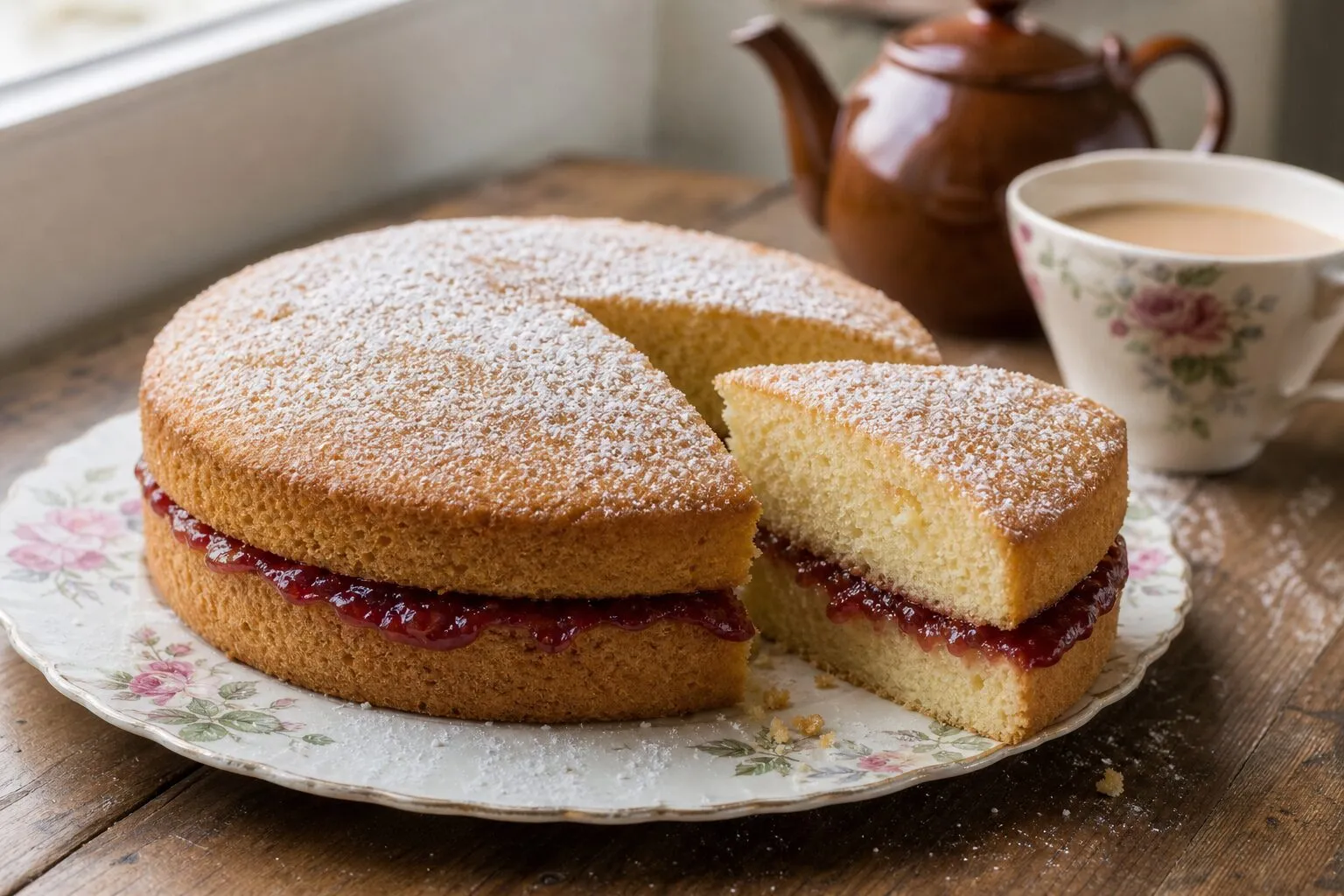
A Victoria sponge is a British cake made of two sponges, baked from equal weights of eggs, butter, sugar and flour, sandwiched together with raspberry jam. The top gets nothing more than a light sprinkling of sugar, with no other decoration. It is a teatime classic and a familiar sight at the shows of the Women’s Institute (WI).
With so few ingredients, there is nowhere to hide mistakes. The WI’s magazine describes it as a cake that tests a baker’s skill. This recipe follows the WI method: the creaming method, in which the butter and sugar are beaten until light and fluffy, with the batter baked in two 20 cm (8 in) sandwich tins.
What is a Victoria sponge?
Because it is made of two layers, it is also called a Victoria sandwich, and that is the name the WI mostly uses. Despite the word “sponge,” it is not a whisked sponge like a génoise, made by beating eggs to a foam. It is a butter-rich batter, closer to a pound cake.
From Mrs Beeton’s “sandwiches”
According to WI Life, the WI’s magazine, the first printed recipe for “Victoria Sandwiches” appeared in Isabella Beeton’s Book of Household Management in 1861. The British magazine Country Life also treats this as the first description of the Victoria sandwich. According to WI Life, the recipe used 4 eggs and their weight in sugar, butter and flour. It contained no raising agent; instead, the batter was beaten well for 10 minutes to work air into it.
In the Country Life article, food historian Annie Gray explains that Mrs Beeton’s version was a square cake, split horizontally, spread with jam and cut into fingers. WI Life also says it was sandwiched with jam and cut into long, narrow fingers. It was quite different from today’s single round cake.
WI Life writes that refined white flour and sugar, together with the invention of baking powder in the 1840s, made it possible to bake fine-textured, buttery cakes. Country Life says that Alfred Bird, known for his custard powder, created baking powder in 1843.
According to WI Life, a sponge sandwich recipe recognizable as the ancestor of today’s appeared in the July 1922 issue of Home & Country, the WI’s magazine. At that point there was still no royal connection. The name “Victoria” first appears in WI publications in 1957. Annie Gray, the food historian, sees two reasons why the cake became a teatime staple: the craving for sweet things after years of postwar rationing, and the special status given to the cake by the WI and others.
The link with Queen Victoria
The official website of the Royal Family and Country Life say the cake is named after Queen Victoria (reigned 1837–1901). But how firmly sources say that the queen actually ate it varies.
- The Royal Family’s website says the cake was named after Queen Victoria, and that the queen ate a slice of sponge cake with her afternoon tea every day.
- The WI Life article (by food writer Mary Gwynn) says the Victoria sponge’s origins go back to the early years of the queen’s reign. It writes that the queen and her ladies-in-waiting enjoyed this new meal of cake and tea to fill the long gap between lunch and dinner. It does not say, however, that the queen ate this particular cake. It notes that the first mention of the queen’s fondness for sponge cake is in a 1927 cookbook from Wiltshire, which only says that it was reputedly her favorite.
- Professor Rebecca Earle, a food historian at the University of Warwick, cites fellow food historian Alysa Levene as saying that the queen enjoyed a version with a single layer of jam at tea parties on the Isle of Wight. She also writes that it is unlikely the queen baked it herself.
- In the Country Life article, Annie Gray says the queen had a sweet tooth, so she probably did eat it. The article also notes, though, that the cake does not appear on the queen’s menus and that there is no evidence.
Victoria sponge recipe: ingredients
Makes: 1 cake, 8 slices (two 20 cm / 8 in round sandwich tins)Prep: 30 min (plus about 1 hour cooling after baking)Bake: 22–27 minutesDifficulty: Easy
For the tins
- Unsalted butter (for greasing the tins)10 g (about 2 tsp)
Sponge
- Unsalted butter (softened at room temperature)200 g (about 1¾ sticks)
- Caster sugar (superfine sugar) (or granulated sugar; the finer the grain, the better)200 g (1 cup)
- Eggs (at room temperature)200 g (about 4 large eggs)
- Plain (all-purpose) flour (in place of self-raising flour (self-rising flour), combined with the baking powder below)200 g (about 1⅔ cups)
- Baking powder8 g (2 tsp)
- Milk (only if the batter is too stiff)0–15 ml (up to 1 tbsp)
Filling and topping
- Raspberry jam (seeded jam is fine)120 g (about 6 tbsp)
- Caster sugar (for sprinkling on top; or granulated sugar)10 g (2½ tsp)
Equipment
- Sandwich tins (shallow round cake pans) (two, 20 cm (8 in) across and 3–4 cm (1¼–1½ in) deep; loose-bottomed tins are easiest to use)
- Parchment paper (cut into two 20 cm (8 in) circles)
- Electric hand mixer
- Silicone spatula
- Sieve
- Digital kitchen scale (for weighing the eggs and baking powder, and for dividing the batter equally between the tins)
- Wire rack (covered with a clean tea towel (dish towel))
Method
Prepare the ingredients and tins
Bring the eggs and butter to room temperature. The butter should be soft enough that a finger pressed into it leaves a dent easily (about 18–21°C / 65–70°F). Preheat the oven to 170–180°C (340–355°F). Grease the insides of the two sandwich tins thinly with 10 g (about 2 tsp) butter, and line the bases with the 20 cm (8 in) circles of parchment paper.
Combine the flour and baking powder
Mix 200 g (about 1⅔ cups) flour with 8 g (2 tsp) baking powder and sift them together twice.
Cream the butter and sugar
Put 200 g (about 1¾ sticks) butter and 200 g (1 cup) caster sugar in a bowl and beat with a hand mixer on high speed for 3–5 minutes. It is ready when the yellow color has faded to pale, and the mixture is light, fluffy and noticeably increased in volume.
Add the eggs a little at a time
Beat 200 g (about 4 large) eggs. Add them 1–2 tbsp at a time, beating well for about 30 seconds after each addition. If the mixture starts to look grainy and curdled, add 1 tbsp (about 8 g) of the flour mixture from step 2 and mix; it will come back together.
Fold in the flour
Sift in the flour mixture from step 2 in 2–3 additions, folding it in with the spatula in big strokes, scooping up from the bottom of the bowl, until no dry flour is visible. Don't beat or overwork the batter. It is the right consistency when a scoop of it drops off the spatula with a light shake. If it is too stiff to drop, add milk ½ tbsp (7.5 ml) at a time, up to 15 ml (1 tbsp).
Divide between the tins and bake
Divide the batter equally between the two tins by weight (about 400 g / 14 oz each) and level the tops. Bake on the middle shelf of the oven for 22–27 minutes. Don't open the oven door for the first 15 minutes. The sponges are done when the tops are golden brown, the edges have shrunk slightly away from the sides of the tins, and the center springs back when pressed lightly with a finger. Also push a skewer into the center of one of them and check that it comes out clean. Use that one as the bottom layer, so the hole doesn't show on top.
Cool
The tins are hot, so use oven mitts. Leave the sponges in the tins for 5 minutes, then run a knife around the edge of each one, turn them out onto the wire rack covered with a tea towel, and peel off the parchment paper. Let them cool completely on the towel, so the rack doesn't leave marks on them (about 1 hour).
Sandwich with jam
Choose the sponge with the nicer top for the top layer. Put the other one on a plate, top side down, and spread 120 g (about 6 tbsp) raspberry jam evenly over its flat upper surface, leaving about 5 mm (¼ in) clear around the edge. Place the top layer on it, top side up, and press down gently. Sprinkle 10 g (2½ tsp) caster sugar lightly over the top.
Cut it into slices and serve it with a pot of tea.
The food science: why the butter and sugar are creamed
Sugar crystals cut air pockets into the butter
The point of beating the butter and sugar for several minutes in step 3 is to create lots of tiny air bubbles in the batter. According to food scientist Harold McGee, the edges of the sugar crystals cut into the soft butter, and air gets into the gaps. The butterfat surrounds these tiny bubbles and holds them in. The mixture turns pale and increases in volume because these bubbles are multiplying. The WI recipe also explains that the more you cream, the more air is trapped, which helps the cake rise.
The consistency of the butter matters here. The crystals can’t cut into cold, hard butter, while butter that is starting to melt can’t hold the bubbles and lets them escape. Aim for butter soft enough that a finger pressed into it leaves a dent, which is about 18–21°C (65–70°F). That is why the butter is brought to room temperature in step 1.
Baking powder enlarges the bubbles
Baking powder is a mixture of bicarbonate of soda (baking soda) and an acidic powder. With moisture and heat, they react and release carbon dioxide. McGee explains that this gas does not create new bubbles; it moves into the existing ones and enlarges them. In other words, the number and fineness of the bubbles you create in step 3 determine the texture of the baked sponge. If the creaming is not enough, the sponge will be coarse and heavy even with baking powder.
In the oven, the air, carbon dioxide and steam in the bubbles expand with the heat. While they hold that shape, the egg proteins set and the starch in the flour gelatinizes (swells with water and heat and turns paste-like), forming the structure of the sponge. If you open the door during baking and the temperature drops, the bubbles collapse before the structure has set, and the center sinks. Don’t open the door for the first 15 minutes.
The food science: eggs a little at a time, flour folded in lightly
Adding the eggs all at once makes the batter curdle
When you add eggs to creamed butter, the water in the eggs disperses into the butter as tiny droplets (an emulsion). Lecithin and other substances in the yolk help the water and fat combine. Add too much at once, though, and the butter can’t hold all the liquid; the mixture separates and looks grainy. Curdled batter also loses the air you worked so hard to trap.
That is why you add the eggs a little at a time, beating well after each addition. Cold eggs chill and harden the butter and make curdling more likely, so bring them to room temperature first. The WI recipe suggests adding some flour if the mixture starts to curdle. The flour absorbs the excess liquid, and the batter comes back together.
Overworking the flour makes the sponge tough
When flour is mixed with liquid, its proteins link up to form a network called gluten. Bread needs it, but in this sponge a strong network makes the batter tough and the cake rises poorly. That is why the flour is folded in lightly, without overworking, in step 5. It is also why the recipe uses a low-protein flour: plain flour, which has less protein than bread flour.
The creaming method and the all-in-one method
In Britain there are two main ways of mixing a Victoria sponge.
- Creaming method: the method in this recipe. The butter and sugar are creamed first, then the eggs and then the flour are added. The WI’s basic recipe, the recipe on the Royal Family’s website and the one from the cookery magazine delicious. all use this method.
- All-in-one method: all the ingredients go into a bowl and are mixed at once. Mary Berry’s recipe uses this method, with baking spread (a margarine for baking) straight from the fridge, beaten with a hand mixer for about 2 minutes until smooth and lighter in color.
For the all-in-one method, both Mary Berry and the WI add 1 tsp baking powder on top of the self-raising flour. This is presumably to make up for the smaller amount of air trapped, since there is no separate step of creaming the butter and sugar. To make it with this recipe’s quantities, increase the baking powder by 4 g (1 tsp) to 12 g (1 tbsp), put all the ingredients in a bowl, and beat with a hand mixer for about 2 minutes. The butter needs to be very soft, soft enough for a finger to sink in easily. Bake it the same way.
The WI recipe says that a sponge made by the all-in-one method doesn’t keep as long as one made the traditional way, and probably won’t win at a show.
Jam and cream: the different camps
What goes in the middle is often debated in Britain.
- Jam only: under the WI’s show judging standards, the filling is raspberry jam, spread generously and evenly, with a light sprinkling of caster sugar on top. Annie Gray also backs jam only; if you want cream, it goes on the side. This recipe follows this style.
- Jam and whipped cream: Mary Berry’s recipe is filled with strawberry jam and whipped double cream (a cream with a high fat content). For the same two 20 cm (8 in) tins, it uses half a 370 g jar of strawberry jam (about 185 g) and 300 ml (1¼ cups) cream. Whip 300 ml (1¼ cups) double cream, or another cream with at least 40% fat, without sugar, until it holds peaks. Spread the cream on the underside of the bottom sponge and the jam on the underside of the top sponge, then place the top sponge on, jam side down.
- Jam and buttercream: the recipe on the Royal Family’s website layers buttercream over the jam. Beat 150 g (about 1⅓ sticks) unsalted butter and 220 g (about 1¾ cups) icing sugar (powdered sugar) until pale, then add ¼ tsp vanilla extract. The top is finished with icing sugar.
A cake filled with cream spoils quickly, so once it is assembled, keep it in the fridge and eat it the same day.
Substitutions
- Self-raising flour: a British flour with raising agent already mixed in. This recipe replaces it with 200 g (about 1⅔ cups) plain flour plus 8 g (2 tsp) baking powder. From the nutrition label (the salt content) of self-raising flour made by the British flour miller Doves Farm, the bicarbonate of soda in the flour was estimated at about 1.2 g per 100 g of flour. The amount here converts that to a baking powder that is about 30% bicarbonate of soda. The proportion of bicarbonate of soda varies between baking powders, so this is partly an estimate. Doves Farm’s own guide for homemade self-raising flour is 2 tsp baking powder per 100 g flour, but that is much more than the label calculation gives, so it is not used here.
- Caster sugar: a fine-grained granulated sugar. Ordinary granulated sugar works instead; a finer-grained sugar blends into the butter faster.
- 20 cm (8 in) sandwich tins: to bake in two 18 cm (7 in) tins, scale the quantities by about 0.8 to match the smaller area. Use 160 g each of butter, caster sugar, eggs (about 3 large) and flour, 6 g (1½ tsp) baking powder and 100 g (about 5 tbsp) jam, and bake for 20–25 minutes. If you have only one tin, you can bake all the batter in a single 20 cm (8 in) round tin at least 6 cm (2½ in) deep, then split it in half horizontally once it has cooled. The Royal Family’s website also says that with a single tin you can bake the cake and cut it in half. It will take longer than baking two layers (35–45 minutes as a guide, but the source recipe doesn’t give a time). Push a skewer right into the center and check that it comes out clean.
Troubleshooting
- The batter curdled: the eggs were too cold, or you added too much at once. Mixing in 1 tbsp flour usually brings it back together.
- The sponge didn’t rise and is coarse and heavy: usually the butter and sugar weren’t creamed enough, or the butter was starting to melt. Overmixing after adding the flour also makes it tough.
- The center sank: the sponge was underbaked, or the oven door was opened during baking. Too much baking powder can also make the bubbles grow too large and collapse.
- The jam soaked into the sponge: if you sandwich the sponges while they are still warm, the jam melts and soaks in. Wait until they have cooled completely.
Storage
- Filled with jam only: keep it in an airtight container so it doesn’t dry out, at cool room temperature, for 2–3 days. The WI recipe says a cake made by the creaming method keeps for several days in an airtight tin.
- Filled with cream or buttercream: wrap it in plastic wrap and keep it in the fridge. Eat a whipped-cream filling the same day, and a buttercream filling by the next day. Mary Berry says to keep a cream-filled cake in the fridge and let it come back to room temperature before serving.
- Freezing: you can wrap each unfilled sponge separately in plastic wrap and freeze it. Mary Berry also says the baked sponges freeze well. Thaw them at room temperature before filling.
Sources
- Mary Berry, “Victoria Sponge Sandwich” (English)
- The Women's Institute, “WI Victoria sandwich” (English)
- WI Life (The Women's Institute), “Let them eat CAKE” (English)
- The Royal Family, “A Royal Victoria Sponge Cake Recipe” (English)
- delicious. magazine, “Classic Victoria sponge recipe” (English)
- Hairy Bikers, “Victoria sponge” (English)
- Country Life, “Victoria sponge: The ultimate test of every baker and a favourite of the nation” (English)
- University of Warwick, “'Queen Victoria truly did enjoy a Victoria sponge' says Food Historian Professor Earle” (English)
- Doves Farm, “How To Make Self Raising Flour” (English)
- Morrisons, “Doves Farm Organic Self Raising White Flour 1kg” (English)
The text and recipe were put together independently after comparing the sources above.