KanelbulleRecipe
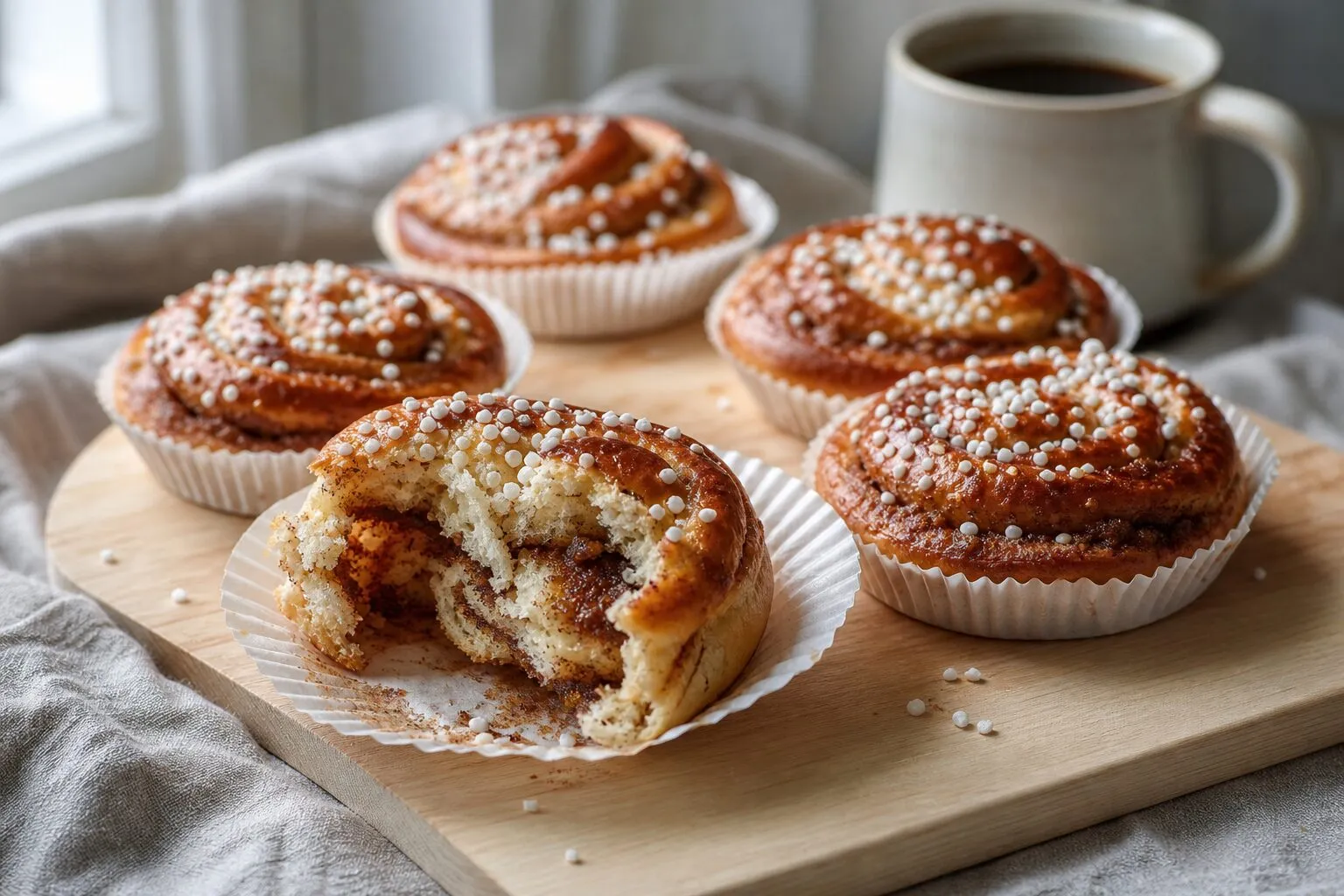
Kanelbullar are Swedish cinnamon buns. A cardamom-scented dough is rolled up with a filling of butter, sugar and cinnamon, cut into small pieces and baked. On top goes pearl sugar, a coarse sugar that doesn’t melt easily in the oven. There is no icing.
Each bun fits in the palm of your hand and bakes in about 10 minutes at a high temperature, so the outside is toasty and the inside stays soft and moist. This recipe follows the way they have been baked again and again in Swedish homes, written for a home oven.
What is a kanelbulle?
In Swedish it is kanelbulle (plural kanelbullar). Kanel means “cinnamon” and bulle means “bun.” In Swedish the e in kanel is long.
Today’s shape dates from the 1920s
According to an article from ICA, one of Sweden’s largest supermarket chains, wheat buns called kanelbulle appear in records from the 1850s. But the bun is thought to have taken its present form around the 1920s, after the First World War, when ingredients became easier to get. At first it was an expensive luxury.
An article from the public broadcaster SVT also dates it to the 1920s and says it became widespread in the 1950s. West Sweden’s tourist board says bakeries started making it first, in the 1920s, and it spread to home kitchens after the Second World War. ICA writes that when butter became cheaper in the 1950s, people bought and baked far more of them.
According to SVT, in the 1950s there were many shapes: snail-like spirals, crescents, buns with cuts in them, pretzel shapes and more. From the 1960s, partly because more women were working outside the home, the quicker method spread: roll up the dough, cut it, and bake the pieces cut side up.
October 4 is Cinnamon Bun Day
Sweden marks October 4 as Cinnamon Bun Day (Kanelbullens dag). It was started in 1999 by Hembakningsrådet (the Home Baking Council), an industry body that promotes home baking. West Sweden’s tourist board and Visit Sweden say it was timed to the council’s 40th anniversary.
According to SVT, the idea came from Kaeth Gardestedt, the council’s project leader at the time. SVT reports that besides getting more people to bake at home, the aim was also to boost sales of flour, yeast and margarine. According to West Sweden’s tourist board, the date was chosen so it wouldn’t clash with any other food day.
Kanelbulle recipe: ingredients
Makes: 24 buns (in paper baking cups about 5 cm / 2 in across the base)Prep: 2 hr 30 min (including two rises)Bake: 20 minutes (baked in 2 batches of 12)Difficulty: Moderate
Dough
- Milk300 ml (1¼ cups)
- Fresh yeast (see Substitutions below for using instant yeast)30 g (about 1 oz)
- All-purpose (plain) flour (to match Swedish vetemjöl, which has about 10% protein)500 g (4 cups)
- Granulated sugar75 g (6 tbsp)
- Salt3 g (½ tsp)
- Cardamom (seeds taken out of the pods and coarsely crushed)4 g (about 2 tsp)
- Butter (softened at room temperature; salted or unsalted both work)90 g (about 6½ tbsp)
Filling (fyllning)
- Butter (softened at room temperature)100 g (about 7 tbsp)
- Granulated sugar60 g (about 5 tbsp)
- Ground cinnamon8 g (about 1 tbsp)
Topping
- Egg50 g (1 large egg)
- Pearl sugar (the small-grained Swedish kind (pärlsocker))30 g (about 1 oz)
For dusting
- Bread flour or all-purpose flour20 g (about 2½ tbsp)
Equipment
- Digital scale (one that weighs in 0.1 g steps is handy for the cardamom and salt)
- Mortar and pestle (for crushing the cardamom seeds)
- Rolling pin
- Paper baking cups (24, about 5 cm (2 in) across the base; without them, set the buns on parchment-lined baking sheets)
- Pastry brush
- Instant-read thermometer (optional, for checking doneness)
Method
Dissolve the yeast in the milk
Warm 300 ml (1¼ cups) milk to 37°C (100°F), body temperature. Crumble 30 g (about 1 oz) fresh yeast into a large bowl, add 30 ml (2 tbsp) of the milk and stir until dissolved, then add the rest of the milk.
Crush the cardamom
Split the cardamom pods, take out the seeds, crush them coarsely in a mortar and weigh out 4 g (about 2 tsp). The number of pods you need depends on their size, so go by weight.
Mix in the flour and butter
Add 75 g (6 tbsp) sugar, 3 g (½ tsp) salt, the 4 g cardamom, and 90 g (about 6½ tbsp) softened butter torn into small pieces to the bowl from step 1. Add 500 g (4 cups) flour a little at a time, mixing by hand until no dry flour remains.
Knead
Turn the dough out onto the counter and knead for 10–15 minutes. It will stick to your hands at first, but don't add flour. It is ready when the surface is smooth and glossy, and a piece about 2 cm (¾ in) square stretched thin between your fingers forms a membrane you can see light through without tearing.
First rise
Shape the dough into a ball, put it in the bowl and cover with plastic wrap or a well-wrung damp cloth. Leave it in a warm place at 25–30°C (75–85°F) for 40–60 minutes, until roughly doubled in size.
Make the filling
Beat 100 g (about 7 tbsp) softened butter, 60 g (about 5 tbsp) sugar and 8 g (about 1 tbsp) cinnamon together with a rubber spatula into a spreadable paste. Don't melt the butter.
Roll out the dough
Dust the counter with the 20 g (about 2½ tbsp) flour. Press the dough lightly to knock out the air and divide it in half. Roll each half into a 25 × 30 cm (10 × 12 in) rectangle; it will be about 6–7 mm (¼ in) thick.
Spread the filling and roll up
Spread half the filling thinly and evenly over each rectangle, right to the edges. Starting from a long (30 cm / 12 in) side, roll the dough up tightly toward you so no gaps form. Pinch the seam closed and turn the log seam-side down.
Cut the buns
Cut each log into 12 pieces 2.5 cm (1 in) wide. To keep the swirl from being squashed, slide a length of cotton thread under the log, cross the ends over the top and pull them apart to cut. Put the pieces cut side up in the paper cups and arrange 12 on each baking sheet.
Second rise and preheat the oven
Cover with a dry cloth and let rise for 30–40 minutes, until the buns are noticeably larger and spring back slowly when pressed lightly with a finger. Keep the second baking sheet in a cool place so it rises more slowly. Twenty minutes before the end of the rise, preheat the oven to 220–230°C (430–445°F).
Brush with egg and add pearl sugar
Beat 50 g (1 large) egg well and brush it thinly over the buns (it is for both batches, and you don't have to use it all). Scatter 15 g of the 30 g pearl sugar over them.
Bake
Bake on the middle rack for 8–10 minutes. The buns are done when the tops and sides are a deep golden brown, the bottom is browned too when you peel back the paper cup of one bun to check, and the center reads 94–98°C (200–210°F). The baking sheet and the melted sugar are very hot, so handle them with thick oven mitts. Brush the second batch with the rest of the egg, scatter the remaining 15 g pearl sugar over it and bake in the same way.
Cool
Cool on a wire rack covered with a dry cloth. The cloth keeps the surface from drying out.
In Sweden, kanelbullar are a fika classic, eaten with freshly brewed coffee. Fika is a break for coffee and something sweet.
The food science: getting a sweet, buttery dough to rise
Plenty of yeast, and milk at 37°C (100°F)
Swedish recipes use a generous amount of fresh yeast, about 6% of the flour weight. In a dough with a lot of sugar, the sugar attracts water and draws it out of the yeast cells, which slows fermentation. That is why more yeast is used. The flour maker Kungsörnen specifies yeast for sweet doughs.
The milk is warmed to around 37°C (100°F) to bring the dough close to the temperature at which yeast works well. Too hot weakens the yeast, and above 50–60°C (120–140°F) it starts to die. The milk should feel lukewarm when you dip a finger in.
Lots of sugar and butter, so knead until a membrane forms
When flour is mixed with liquid and kneaded, its proteins link up into a network called gluten. This network traps the gas the yeast gives off, like a balloon, and makes the dough rise.
Fat from the butter coats the proteins and gets in the way of them linking up. Sugar also competes for water, so gluten forms less easily. Kanelbulle dough has a lot of both sugar and butter, so the network takes longer to develop. All seven Swedish recipes read for this article add the butter from the start (some add softened butter with the flour, others add melted butter with the milk). This recipe also adds softened butter at the start. The ICA and Kungsörnen recipes, which give a time for kneading by hand, say 10–15 minutes. Rather than going by time, check whether the dough stretches thin into a membrane.
Crush the cardamom seeds yourself
The aroma compounds in cardamom are volatile and escape quickly once it is ground. Most Swedish recipes use seeds taken out of the pods and crushed, rather than ground cardamom. Crushing them just before use keeps the most aroma.
The food science: why bake hot and fast
All seven Swedish kanelbulle recipes read for this article bake at a high 225–250°C (435–480°F) for a short 5–12 minutes. Small cut buns heat through to the center quickly.
At high heat the surface warms fast, and color and toasty flavor develop right away through the Maillard reaction, in which sugars and proteins in the dough react, and through caramelization, in which the sugar browns. The egg brushed on top deepens the color too. Meanwhile the center reaches 94–98°C (200–210°F), and the starch absorbs water and swells (gelatinization), so the crumb sets soft and light.
Baked longer at a lower temperature, the dough loses moisture before it browns and turns dry. The butter in the filling also has more time to melt and run out. For kanelbullar of the kind Swedes call saftig (moist, juicy), bake them quickly in a hot oven.
Shaping: rolled or knotted
This recipe uses the rolled-and-cut “snail” shape. In Sweden you also often see buns shaped like a knot. You can make them with the same dough and filling:
- Roll the dough out to 25 × 30 cm (10 × 12 in) as in step 7, spread the filling over the whole surface, and fold it in half, bringing the long sides together, to make a 12.5 × 30 cm (5 × 12 in) rectangle.
- Cut it into 12 strips 2.5 cm (1 in) wide.
- Hold each strip by both ends and twist it while stretching it lightly. Wrap it around two or three fingers, then pass the end through the hole in the middle and tuck it underneath.
- Place on a parchment-lined baking sheet, then rise and bake as from step 10.
ICA’s Kanelsnurror are brushed after baking with a syrup of sugar and water boiled together, which gives them a shine. ICA’s cardamom recipe puts cardamom in the filling as well.
How they differ from American cinnamon rolls
As a recipe for American-style cinnamon rolls, ICA gives one where 12 rolls are set side by side in a pan and baked together, left in the pan for about 15 minutes, and then spread with a powdered sugar icing.
All seven Swedish kanelbulle recipes read for this article bake the buns one by one in paper cups or on a baking sheet, brush them with beaten egg and scatter pearl sugar over them (Kungsörnen says chopped almonds are fine too, and ICA’s Kanelsnurror are also brushed with syrup after baking). None of them uses icing. Cardamom in the dough is another Swedish touch: four of the seven recipes add it, and one adds it as an option.
Substitutions
- Fresh yeast: use 10 g (a little over 3 tsp) instant dry yeast instead. Don’t dissolve it in the milk in step 1; add it with the flour in step 3. Because this dough is high in sugar, a yeast labeled for sweet doughs (osmotolerant) suits it.
- Pearl sugar: you can find it at baking supply stores or online. The small grains work better than the large pearls sold for waffles. If you can’t get it, put 30 g (about 1 oz) sugar cubes in a heavy bag and crush them with a rolling pin into pieces a few millimeters across. The Kungsörnen recipe also suggests topping the buns with chopped almonds.
- Cardamom seeds: you can use 4 g (2 tsp) ground cardamom instead. The aroma will be weaker than with freshly crushed seeds.
- Paper baking cups: without them, arrange the buns on a parchment-lined baking sheet with space between them. They spread as they bake, so put no more than 10–12 on each sheet.
Troubleshooting
- The bottoms burned, or the filling ran out: the heat from the bottom of your oven may be too strong, or the butter in the filling may have melted. ICA’s recipe that bakes at 250°C (480°F) has many comments saying the buns burned. For the next batch, lower the oven to 220°C (430°F) and peel back a paper cup early to check the color of the bottom. Spread the filling as a paste without melting it, and roll the dough up without gaps.
- Dry or tough: they may have been overbaked, or flour may have been added during kneading. Take them out early, going by color and internal temperature, and keep kneading without adding flour even if the dough is sticky.
- They didn’t rise, or they’re heavy: the milk may have been too hot and weakened the yeast, or the dough may not have risen long enough. On cold days rising takes longer. Judge by size, not by time.
- The swirl got squashed or came undone: pressing down with a knife squashes the swirl. Cut with thread, and put the buns in the paper cups with the end of the roll underneath.
Storage
- Room temperature: once cooled, put them in a bag and seal it. They keep until the next day.
- Freezing: wrap each bun in plastic wrap and put them in a freezer bag. They keep for up to 2 months (Arla says 2–3 months frozen). Thaw at room temperature and warm for 1–2 minutes in a toaster oven.
More from The Nordic countries
Sources
- ICA, “Kanelbullar med kardemumma” (Swedish)
- ICA, “Saftiga kanelbullar” (Swedish)
- ICA, “Kanelsnurror” (Swedish)
- ICA, “Cinnamon rolls med glasyr” (Swedish)
- ICA, “Kanelbullens dag 2027” (Swedish)
- Arla, “Kanelbullar” (Swedish)
- Arla, “Lyxiga kanelbullar” (Swedish)
- Arla, “Kanel- och kardemummabullar” (Swedish)
- Kungsörnen, “Kanelbullar - grundrecept” (Swedish)
- ICA Handla, “Vetemjöl 2kg Kungsörnen” (Swedish)
- SVT Nyheter, “Kanelbullens egna dag” (Swedish)
- SVT Nyheter, “Kanelbullens dag blir myndig” (Swedish)
- Västsverige, “Vad vet du om Kanelbullens dag?” (Swedish)
- Visit Sweden, “Fira Sveriges sötaste tradition” (Swedish)
- The Local Sweden, “Swedish word of the day: kanelbulle” (English)
The text and recipe were put together independently after comparing the sources above.