KladdkakaRecipe
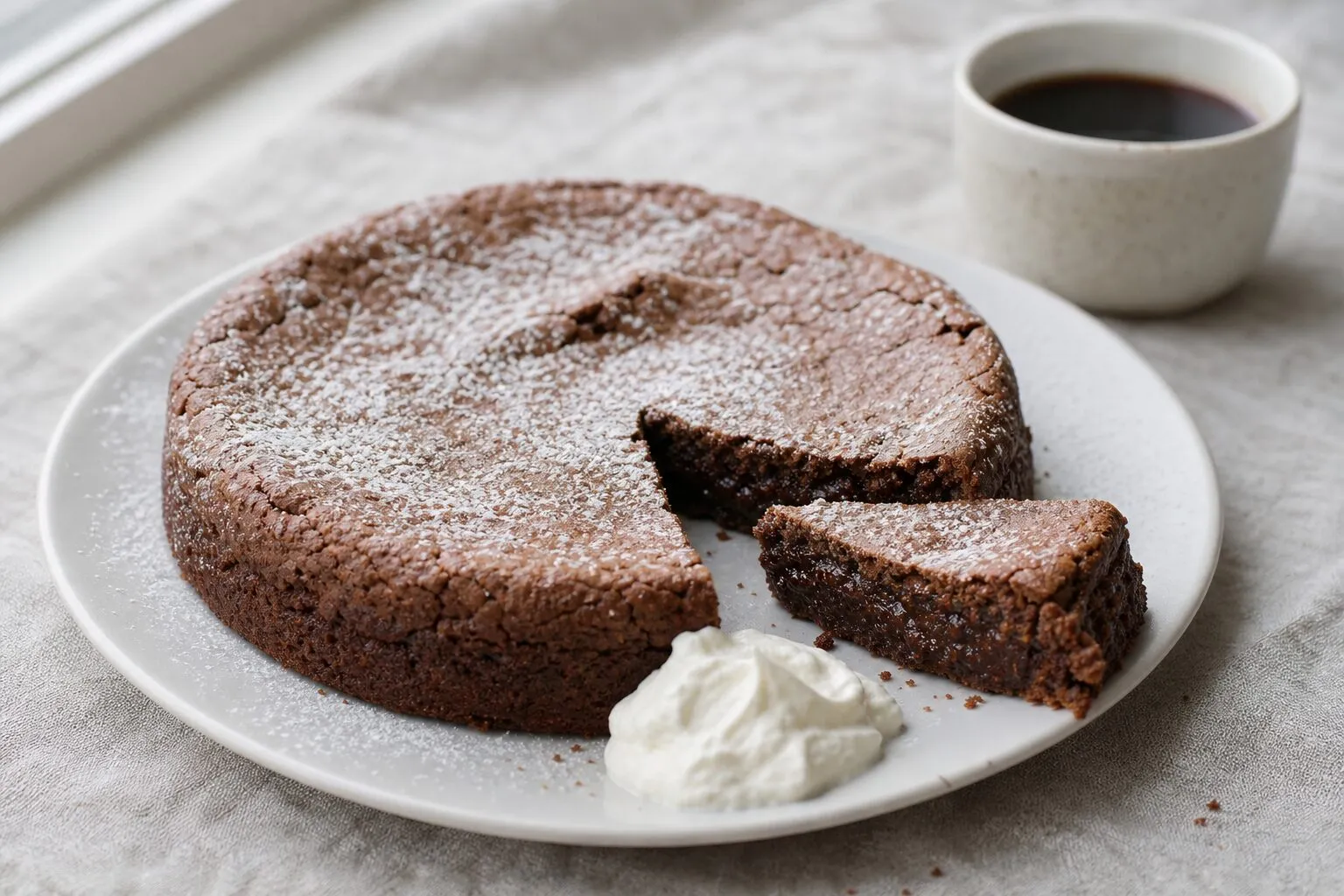
Kladdkaka is a chocolate cake familiar in homes all over Sweden. You simply mix sugar, cocoa, eggs and a little flour into melted butter. There is no baking powder. The edges and top bake firm, while the inside stays gooey.
It bakes in about 15–20 minutes, and it comes out of the oven while the center still wobbles when you shake the pan. Most of the Swedish recipes read for this article use a 24 cm (9½ in) pan; this recipe scales the amounts down to a 21 cm (8¼ in) pan by the ratio of their areas.
What is kladdkaka?
The name is Swedish. It comes from the adjective kladdig, meaning “sticky” or “gooey,” and kaka means “cake.” In Swedish, the a in kladd is short and the first a in kaka is long.
West Sweden’s tourist board (Västsverige) describes it as a rich, dense, gooey cake made from eggs, flour, sugar, butter and cocoa. Because it is so easy to make, it is often one of the first cakes children bake on their own. The Swedish food publication SENSES says there is no fixed standard, but lists its requirements as gooey, dense and full of chocolate flavor.
Several origin stories
Nobody knows for certain when or where kladdkaka was born. An article in SENSES, saying it could not verify any of them, gives three theories:
- That in 1968 a food writer for the weekly magazine Veckojournalen came across it in a Paris café
- That it was created in Sweden during the Second World War, when baking powder was hard to come by
- That it was based on the American brownie
The business news site Dagens PS, citing the supermarket chain ICA, reports that Margareta Wickman, a food writer at Veckojournalen, ate a gooey chocolate cake at a restaurant near a Paris flea market in the late 1970s, brought the recipe home and published it in the magazine, where it was a huge hit. The year of the Paris visit does not match the one in the SENSES article.
November 7 is Kladdkaka Day
In Sweden, November 7 is Kladdkaka Day (Kladdkakans dag). Dagens PS, citing Svenska högtider, which keeps track of Swedish observances, reports that the idea of celebrating the day grew out of conversations on social media.
Kladdkaka recipe: ingredients
Makes: One 21 cm (8¼ in) springform pan (8 slices)Prep: 15 minutesBake: 15–20 minutes (plus at least 1 hour to cool)Difficulty: Easy
Preparing the pan
- Butter (softened at room temperature)5 g (1 tsp)
- All-purpose (plain) flour5 g (about 2 tsp)
Batter
- Salted butter (if using unsalted butter, see Substitutions)100 g (7 tbsp)
- Granulated sugar210 g (about 1 cup)
- Unsweetened cocoa powder (pure cocoa, with no added sugar or milk powder)20 g (about ¼ cup)
- Vanilla sugar, or oil-based vanilla flavoring (vanilla sugar is the Swedish vaniljsocker; see Substitutions)3 g (1 tsp), or 5 drops
- Eggs (at room temperature)100 g (2 large eggs)
- All-purpose (plain) flour (in place of the Swedish wheat flour (vetemjöl))70 g (½ cup + 1 tbsp)
To finish and serve
- Powdered (icing) sugar5 g (about 2 tsp)
- Heavy (whipping) cream (at least 35% fat)200 ml (a generous ¾ cup)
Equipment
- Springform pan (21 cm (8¼ in) across; Swedish recipes often use 24 cm (9½ in))
- Small saucepan (about 2 liters (2 quarts); the batter is mixed in it too)
- Silicone spatula
- Sieve
- Wooden or bamboo skewer
- Wire rack
- Small fine-mesh strainer (for dusting the powdered sugar)
- Hand mixer (for whipping the cream; a whisk also works)
Method
Prepare the pan and oven
Preheat the oven to 170–180°C (340–355°F). Brush the inside of the pan thinly with 5 g (1 tsp) softened butter. Add 5 g (about 2 tsp) flour and tilt and turn the pan to coat the bottom and sides. Tap out the excess flour.
Melt the butter
Put 100 g (7 tbsp) salted butter in the saucepan and melt it over low heat. As soon as it has melted, take it off the heat and let it stand for about 5 minutes, until the bottom of the pan feels warm to your hand (40–50°C / 105–120°F).
Stir in the sugar and cocoa
Add 210 g (about 1 cup) sugar, 20 g (about ¼ cup) cocoa and the vanilla (3 g / 1 tsp vanilla sugar, or 5 drops vanilla flavoring) to the pan and mix well with the spatula. If lumps of cocoa remain, press them against the side of the pan to break them up.
Mix in the eggs
Beat 100 g (2 large) eggs and add them in 2 additions. Each time, fold with broad strokes from the bottom with the spatula, taking care not to whip in air. The batter is ready when it looks glossy all over.
Mix in the flour
Sift in 70 g (½ cup + 1 tbsp) flour and mix with the spatula until no dry flour is visible. Once the flour has disappeared, stop mixing.
Bake
Pour the batter into the pan and level the top. Bake on the middle rack for 15–20 minutes, checking from 14 minutes on. Take it out while the edges are set and dry, a thin crust has formed over the whole top, and the center still wobbles when you gently shake the pan. A skewer pushed into the center should come out with thick, gooey batter on it. The cake keeps cooking from its own heat after it comes out, so if in doubt, stop before it firms up. The egg in the center does not set completely, so if you are serving young children, older people or anyone who is pregnant, bake until the skewer comes out clean. The pan is very hot when it comes out of the oven, so handle it with thick oven mitts.
Cool
Set the cake, still in its pan, on a wire rack and leave it for at least 1 hour to cool completely. It breaks easily while warm, so don't take it out of the pan yet. Once cool, chilling it in the fridge for about 1 hour gives cleaner slices.
Finish
Remove the side and base of the pan and set the cake on a plate. Dust with 5 g (about 2 tsp) powdered sugar through a small strainer. Whip 200 ml (a generous ¾ cup) cream, without sugar, until it forms soft peaks that droop gently when you lift the whisk. Cut the cake into 8 slices and serve with the whipped cream.
Serve it with whipped cream, vanilla ice cream or berries, and a cup of coffee. West Sweden’s tourist board says it is best served slightly warm.
The food science: no raising agent, and a gooey center
No rise means a dense texture
The recipe from the flour brand Kungsörnen explains that kladdkaka is gooey because it contains no baking powder.
Baking powder releases carbon dioxide in the batter. It does not create new bubbles, though. The gas moves into the tiny air bubbles that get into the batter during mixing, enlarges them, and makes the batter rise.
Kladdkaka uses melted butter. Unlike creaming, where softened butter is beaten with sugar, melted butter does not trap air. With no raising agent either, the batter sets with few bubbles in it, giving a heavy, dense texture. Mixing the eggs without whipping them is also a way of keeping air out.
Lots of sugar slows down the eggs and starch
A cake batter sets because the egg proteins firm up with heat and the starch in the flour absorbs water and swells (gelatinizes). Egg whites begin to set in the low 60s°C (roughly 140–145°F), and yolks in the high 60s°C (roughly 150–155°F).
Sugar delays both. It gets between the egg proteins and raises the temperature at which they set. Starch needs water to gelatinize, but sugar competes for that water, so the starch sets less easily too. In this recipe there is three times as much sugar as flour. That is what lets the edges bake firm while the center has not yet fully set.
The test: firm edges, wobbly center
The recipe from the dairy company Arla describes the cake as done when the edges are firm and dry, a thin crust has formed on top, and the center is still wobbly and gooey. It also says that, because the cake keeps cooking from its own heat after it comes out, slightly underdone is better than too firm. If you bake it until the center has set all the way through, the gooey texture is lost.
Even if the center is loose straight out of the oven, it firms up as it cools. Butterfat melts at around body temperature and sets when chilled. That is also why Arla recommends resting the cake in the fridge before serving.
The egg in the center does not fully set. If you are serving young children, older people, anyone who is pregnant, or others who need to be careful, bake until a skewer pushed into the center comes out clean.
The food science: the ratio of cocoa to sugar
In the five Swedish recipes read for this article, the cocoa weighed 7–19% as much as the sugar. They fall into two groups: those that use 3–4 tablespoons, and those that use more, measured with a deciliter (100 ml) measure. The cocoa in this recipe is about 10% of the sugar, in the middle of the five.
Cocoa powder is ground cacao with part of the fat (cocoa butter) pressed out, and depending on the product it contains from about 10% to a little over 20% fat. Most of the rest is fine particles of fiber, starch, protein and so on, which absorb water. More cocoa gives a stronger chocolate flavor, but the particles soak up moisture from the batter, making it drier and firmer in the mouth. Bitterness and astringency increase too.
Sugar, on the other hand, attracts water and holds on to it. Dissolved in the water from the eggs, it becomes something like a syrup, which keeps the center moist even after baking. The thin crust on top is thought to form as moisture evaporates from the surface and the sugar dissolved in the eggs dries out. So kladdkaka’s large amount of sugar is not only for sweetness: it also creates the gooey center and the crust on top. If you follow this formula, don’t cut back the sugar.
Variations
- Brown butter: ICA has a recipe in which the butter is heated in the pan until it turns brown and smells nutty, then cooled slightly before use. Browning butter foams and spatters, and the pan gets hot, so take care not to burn yourself.
- Salt: the same ICA recipe adds flaky salt to the batter. The recipe on the Thatsup blog “stockholmandme” sprinkles sea salt over the top 10 minutes before the end of baking.
- Lower heat, longer bake: the Kungsörnen recipe pours the batter into a pie dish and bakes it at 150°C (300°F) for 30–40 minutes.
- Made with chocolate: the SENSES recipe uses no cocoa. Instead, melted butter is poured over chopped 70% chocolate to melt it, and the cake is baked in a pan dusted with coconut.
- Mixing method: another ICA recipe stirs the eggs and sugar together in a bowl, then adds the melted butter, followed by the dry ingredients.
- Preparing the pan: Arla’s recipe and ICA’s brown butter recipe butter the pan and then coat it with fine dry breadcrumbs (ströbröd) instead of flour.
Substitutions
- Vanilla sugar (vaniljsocker): Swedish recipes add 1–2 tsp of vanilla-flavored sugar. If you don’t have any, add 5 drops (about 0.2 ml) of oil-based vanilla flavoring in step 3 instead. Vanilla extract also works, though its aroma fades more during baking.
- Salted butter: three of the five Swedish recipes read for this article add no salt to the batter. Arla’s salted butter contains 1.2% salt. If you use unsalted butter, add 1 g (scant ¼ tsp) salt in step 3.
- Cocoa: don’t use sweetened cocoa (hot chocolate mix) that contains sugar or milk powder. It changes the sweetness and texture a great deal.
- Baking in an 18 cm (7 in) pan: multiply the batter ingredients by about 0.73 (75 g / about 5½ tbsp salted butter, 155 g / about ¾ cup sugar, 15 g / about 3 tbsp cocoa, 75 g / 1½ large eggs, 50 g / ⅓ cup + 1 tbsp flour, and about ¾ tsp vanilla sugar or 4 drops vanilla flavoring). The cake is the same thickness, so the baking time is about the same. Start checking after 13 minutes.
- No springform pan: line the bottom and sides of an ordinary round cake pan with parchment paper. Once the cake has cooled, lift it out by the paper.
Troubleshooting
- Firm and dry all the way through: it was overbaked. Even if you take it out while the center wobbles, the remaining heat and cooling will firm it up. Next time, take it out 2–3 minutes sooner.
- The center runs out when cut: it may not have baked long enough, or you may have cut it before it had cooled completely. Let it cool fully and chill it in the fridge before cutting.
- It rose and turned out like an ordinary cake: air may have got in if you mixed the eggs as though whipping them. Mix with a spatula, without making bubbles.
- Bits of cooked egg in the batter: if the eggs go into the melted butter while it is too hot, some of the egg sets. Let the butter cool until it just feels warm to your hand, and add the eggs after the sugar and cocoa.
Storage
- Fridge: wrapped in plastic wrap or in an airtight container, up to 4 days (Arla says 5–7 days in the fridge). The egg in the center is not fully set, so eat it sooner rather than later.
- Freezer: once completely cool, cut into slices, wrap each in plastic wrap, put them in a freezer bag, and freeze for up to 3 months (according to Arla). Thaw slowly in the fridge.
More from The Nordic countries
Sources
- Arla, “Kladdkaka” (Swedish)
- ICA, “Bästa kladdkakan” (Swedish)
- ICA, “Kladdkaka med brynt smör” (Swedish)
- Kungsörnen, “Kladdkaka - grundrecept” (Swedish)
- Thatsup (stockholmandme), “Världens godaste och enklaste kladdkaka” (Swedish)
- SENSES, “Veckans recept: Kladdkaka med chokladkräm och sotade apelsinfiléer” (Swedish)
- Dagens PS, “Kladdkakans dag – bara toppen på ett isberg” (Swedish)
- Västsverige, “Klassiska svenska bakverk” (Swedish)
- ICA Handla, “Vetemjöl 2kg Kungsörnen” (Swedish)
- ICA Handla, “Smör Normalsaltat Svenskt 82% Ekologisk 250g Arla” (Swedish)
- Wikipedia, “Kladdkaka” (English)
The text and recipe were put together independently after comparing the sources above.