CaneléRecipe
cannelé
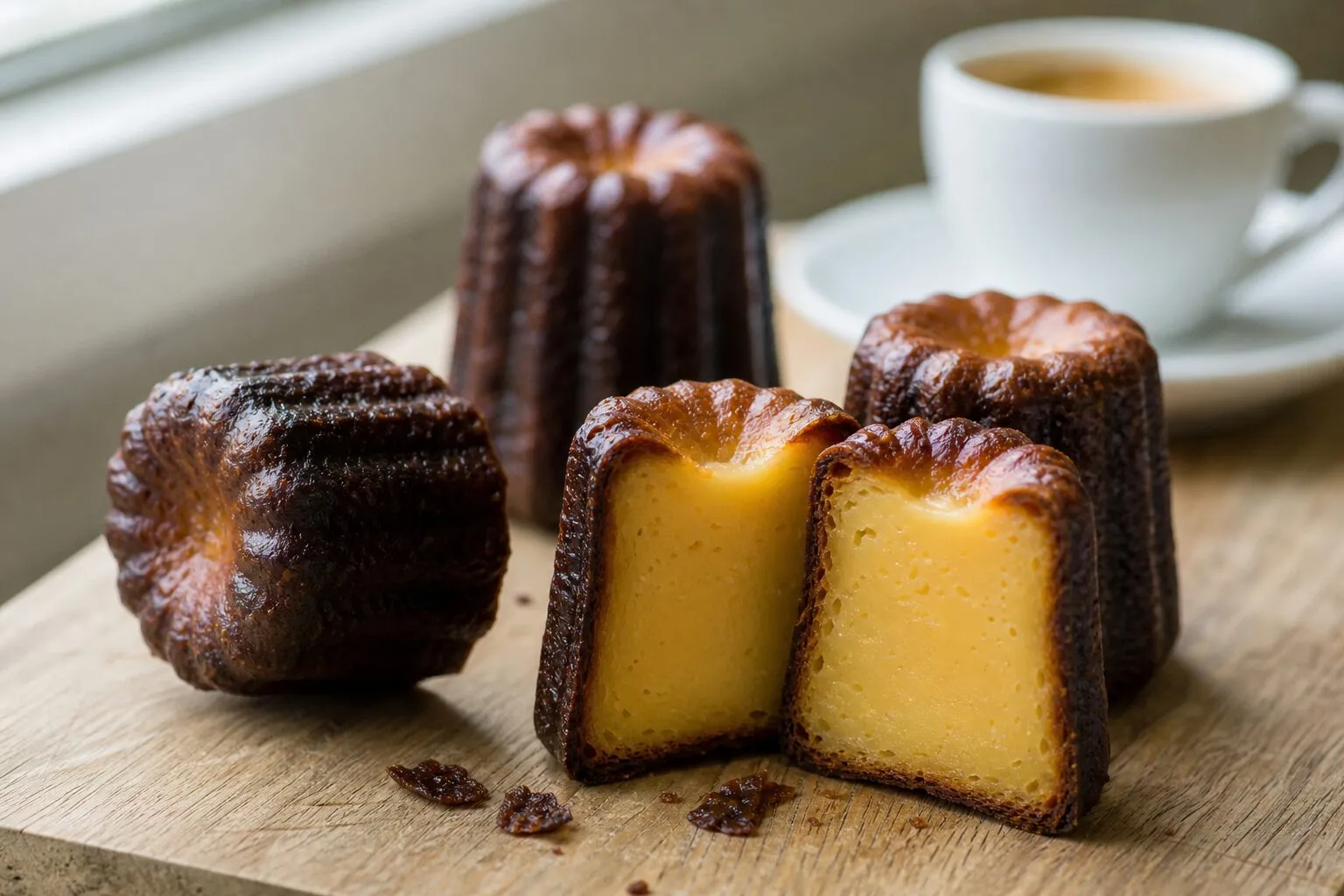
Canelés are small baked pastries from Bordeaux. They are shaped like a fluted bell, with a caramel shell on the outside, baked to just short of burning, and a soft, custard-like center inside. They smell of rum and vanilla.
The ingredients are everyday ones: milk, sugar, eggs, flour and butter. The hard parts are resting the batter for more than a full day, preparing the molds, and baking them. This recipe is built around the formula of Bordeaux pastry chef Cyril San Nicolas, compared with other French recipes, and written as steps you can follow in a home oven.
What is a canelé?
In French it is written cannelé, which means “fluted.” The Bordeaux pastry shop Baillardran explains that the name comes from the fluted copper molds the pastries are baked in. French Wikipedia, on the other hand, also suggests that the name may have come first, with fluted molds adopted later to match it.
The one-n spelling
Pastry makers who belong to Bordeaux’s canelé association write it canelé, with one n. Baillardran and Wikipedia explain that when bakers founded the association, the Confrérie du canelé de Bordeaux, in 1985, they dropped one n to mark their pastry as distinctive. The one-n spelling is the association’s collective trademark.
The other French sources read for this article, though, mostly use the original two-n spelling: a web magazine, a radio station’s website, a restaurant guide, the national tourism website and a Bordeaux bookshop’s website. This English edition writes canelé, and gives cannelé alongside it as the spelling those general sources use more widely.
Many origin stories
The most often told story is that nuns at the Annonciades convent in Bordeaux created it. Gault&Millau, the French restaurant guide, and the website of the radio station Europe 1 place this in the 16th century. Baillardran tells a version set in the 18th century, while noting that nobody knows whether it is true. According to Gault&Millau, the pastry of that time went by names such as canelat and was made by wrapping dough around thin stems and frying it. French Wikipedia says the convent’s pastry was fried in lard and did not resemble today’s canelé.
The link with wine also comes up often. Bordeaux châteaux (wine estates) use whipped egg whites to clarify their wine, a step called fining (collage in French). The story goes that the leftover yolks were given to the nuns, who used them in pastries. Wikipedia notes that rum, vanilla and cane sugar are ingredients that recall the colonial trade through the port of Bordeaux.
Another theory is that the canelé grew out of the canaule, a bread made with egg yolks. Gault&Millau says it was made in the 17th century by craftsmen called canauliers. Wikipedia describes the canaule as a 19th-century bread made with egg yolks, and adds a note that the name canaulier does not appear in 19th-century registers of craftsmen.
Reliable records are recent. According to Slate.fr, the canelé in its present form does not appear in documents until the 20th century. According to Wikipedia, it was fashionable in Bordeaux in the 1930s and, after the Second World War, faded away except among long-established wealthy Bordeaux families. From the early 1980s it gradually came back into favor, and Jacques Chaban-Delmas, the mayor of Bordeaux, is said to have helped make it the city’s specialty by serving it often at receptions at City Hall.
The ratios in this recipe
San Nicolas’s formula uses 250 g sugar, 150 g flour, 1 whole egg plus 3 yolks, 25 g butter and 50 g rum for every 500 g milk. Of the 150 g flour, 50 g is cornstarch. The recipe in the Europe 1 article and the one by Paris pastry chef Jacques Genin use wheat flour only. This recipe also uses only wheat flour, and sets the amount at 120 g to match the proportion in those two recipes (22–24% of the weight of the milk). All three recipes have one thing in common: the sugar weighs almost half as much as the milk.
Genin’s recipe makes 24 canelés from 1 kg milk. This recipe makes 12 from 500 g milk, which is the same proportion. Each canelé takes about 85 g (3 oz) of batter.
Canelé recipe: ingredients
Makes: 12 canelés (molds 5.5 cm / 2¼ in across, 5 cm / 2 in tall)Prep: 24 hr 40 min (including resting the batter for at least 24 hours)Bake: About 1 hourDifficulty: Challenging
Batter
- Whole milk375 g (about 1½ cups)
- Whole milk (cold, straight from the fridge)125 g (about ½ cup)
- Vanilla bean1
- Unsalted butter25 g (about 1¾ tbsp)
- Granulated sugar250 g (1¼ cups)
- All-purpose (plain) flour (in place of the French T45 or T55 wheat flour)120 g (about 1 cup)
- Egg50 g (about 1 large egg)
- Egg yolks60 g (about 3 large egg yolks)
- Dark rum (aged dark rum)50 ml (about 3½ tbsp)
Preparing the molds (copper)
- Beeswax (labeled food-grade (not candle or craft wax))20 g (about ¾ oz)
- Unsalted butter20 g (about 1½ tbsp)
Preparing the molds (silicone)
- Unsalted butter (used instead of the beeswax and butter for copper molds)15 g (about 1 tbsp)
Equipment
- Copper canelé molds (12 molds, about 5.5 cm (2¼ in) across and 5 cm (2 in) tall)
- Silicone canelé mold (if using instead of copper molds)
- Cooking thermometer (to check the temperature of the milk)
- Oven thermometer (to check the temperature inside the oven)
- Whisk
- Fine-mesh sieve
- Pastry brush
- Wire rack
Method
Infuse the milk with vanilla (1–2 days before baking)
Split the vanilla bean lengthwise and scrape out the seeds with the back of a knife. Put 375 g (about 1½ cups) milk, the vanilla seeds and pod, and 25 g (about 1¾ tbsp) butter in a saucepan over medium heat. When the milk bubbles at the edges and is about to boil, take it off the heat. Add the 125 g (about ½ cup) cold milk to bring the temperature down, and let it stand until a cooking thermometer reads 50°C (120°F) or below. Squeeze the remaining seeds out of the pod, then remove the pod.
Combine the sugar, flour and eggs
Put 250 g (1¼ cups) sugar and 120 g (about 1 cup) flour in a bowl and mix with a whisk. Make a well in the center, add 50 g egg (about 1 large) and 60 g egg yolks (about 3 large), and beat the eggs inside the well only.
Add the milk in 4 additions
Add the milk from step 1 in about 4 additions. Each time, move the whisk in small circles in the center, drawing in the surrounding flour gradually from the inside out. The key is to mix without whisking air into the batter. When it is smooth, stir in 50 ml (about 3½ tbsp) rum.
Strain and rest for 24–48 hours
Strain the batter through a fine-mesh sieve to remove any lumps. Press plastic wrap directly onto the surface and refrigerate for at least 24 hours, ideally 48 hours.
Coat the molds with beeswax (copper molds)
Warm the molds in an oven at around 100°C (210°F) for about 5 minutes. Melt 20 g (about ¾ oz) beeswax and 20 g (about 1½ tbsp) butter in a small saucepan over very low heat or in a water bath. Melted beeswax is hot and will burn your skin. Don't heat it until it smokes, and stay by the stove. The warmed molds are hot too, so handle them with oven mitts. Pour the melted beeswax into each mold and pour it straight back out, then turn the mold upside down on a rack to let the excess drip off, leaving a thin film inside. Chill in the fridge for 30 minutes to set. For silicone molds, brush 15 g (about 1 tbsp) melted butter inside, right into the grooves, and chill in the fridge.
Stir the batter again and fill the molds
Preheat the oven to 250°C (480°F), and check with an oven thermometer that it has reached about 250°C (480°F). Take the batter out of the fridge and stir it gently, without whisking, to bring back the flour that has settled at the bottom. Set the chilled molds on a baking sheet and fill them to 1–2 mm (1/16 in) below the rim. Put silicone molds on the baking sheet before filling them.
Bake at high heat to set the outside
Bake at 230–250°C (445–480°F) for 12–15 minutes. When the top edges start to color, move on to the next step. If the batter rises more than 1 cm (½ in) out of the molds during this time, take out the whole baking sheet, wait 1–2 minutes until the batter sinks back, then return it to the oven.
Lower the heat and bake slowly
Lower the oven to 180–190°C (355–375°F) and bake for 40–50 minutes. Bake silicone molds 10–15 minutes longer. The canelés are done when the tops and sides are a deep brown (mahogany) and the color reaches right into the grooves. Unmold one to check; if the sides are still pale, put it back in its mold and bake 5–10 minutes more.
Unmold while hot
The molds, the baking sheet and the caramel inside are very hot, so take them out wearing thick oven mitts. Keeping your face away, turn the molds upside down while still hot and tap them against the rack to release the canelés. Let them cool on the rack for 1–3 hours, until the outside is crisp, before eating.
Eat them with your fingers within a few hours of baking and cooling, while the outside is still crisp. They go well with coffee or tea. You will have 3 egg whites left over; use them for financiers or other bakes.
The food science: why the batter rests for 24 hours or more
The flour absorbs water and the batter comes together
Canelé batter is thin and runny, like crêpe batter. Right after mixing, the starch granules in the flour have not yet absorbed all the water they can. Slate.fr explains that while the batter rests, the starch swells and thickens it slightly, and the vanilla and rum flavors become stronger.
While it rests, the flour also settles to the bottom. That is why you stir the batter gently again before baking. Slate.fr’s recipe also says to stir in circles without whisking. Bubbles in the batter expand in the oven, and this is thought to be one of the reasons the batter climbs out of the molds.
Why the milk is cooled to 50°C (120°F) before it goes into the eggs
Egg proteins set with heat. If you add hot milk to eggs all at once, the egg around the edges sets into crumbly lumps. Slate.fr’s recipe adds cold milk to the boiled milk to bring it below 50°C (120°F) before combining. This recipe does the same.
The food science: caramel outside, custard inside
Outside: the sugar in the batter browns against the mold
Canelé batter contains half the milk’s weight in sugar. Milk and eggs also contain protein and lactose (milk sugar). On the outside, where the batter touches the mold, the temperature climbs above 100°C (212°F) once the water has evaporated. There, two things happen: the Maillard reaction, in which amino acids and sugars react to create color and flavor, and, at even higher temperatures, caramelization, in which the sugar itself browns. Because the batter is so rich in sugar, a hard, dark shell forms on the outside, and it turns crisp as it cools.
The Europe 1 article says that starting at a high temperature of 250–270°C (480–520°F) uses the temperature difference to make the outside crisp. Home ovens lose heat easily when the door is opened, so preheat thoroughly.
Inside: no hotter than 100°C (212°F) while there is water
The inside holds a lot of water, so even during baking it hardly rises above 100°C (212°F) and does not brown the way the outside does. At that temperature the egg proteins set and the flour’s starch absorbs water and turns paste-like (gelatinization), so the center sets softly, like a baked custard. Because the recipe uses about four times as much milk as flour, the inside does not become a dry cake; it stays moist and dense.
Copper molds, beeswax and silicone molds
The Europe 1 article recommends copper molds, saying copper conducts heat much better than other materials. French Wikipedia also says canelés are baked in small molds that conduct heat well. Copper molds pass the oven’s heat to the batter quickly, so the color reaches deep into the grooves more easily. Slate.fr also treats tin-lined copper molds as very important. Tin melts at around 232°C (450°F), so do not leave tin-lined molds empty in a hot oven for long. Slate.fr writes that washing them with detergent damages the tin. After use, rinse them with hot water and dry them.
Silicone conducts heat less well than metal. In silicone molds the outside does not heat up as easily, so the shell tends to be thinner and lighter in color. Slate.fr says silicone molds still give good results, but advises baking a little longer.
Beeswax is the wax that honeybees build their combs from. It forms a thin film inside the mold that helps the baked canelés come out. Gault&Millau’s article, describing the canelés at Les Sources de Caudalie near Bordeaux, says the beeswax forms a film on the surface of the canelé that keeps water out and gives it its crisp texture. Jacques Genin’s recipe mixes beeswax half and half with butter, and this recipe does the same.
Substitutions
- Food-grade beeswax: Slate.fr says you can use clarified butter (butter fat with the water and milk solids removed) instead. Melt 40 g (about 3 tbsp) butter over low heat, skim the foam off the top, and use only the clear fat, leaving the white milk solids at the bottom. Plain butter is more likely to burn because of its milk solids. If you do use beeswax, always choose one labeled food-grade, never wax sold for candles or crafts.
- Copper canelé molds: you can bake canelés in silicone molds too. Set them on a baking sheet and bake 10–15 minutes longer. Metal molds brown better than silicone ones.
- Vanilla bean: use 5 ml (1 tsp) vanilla extract instead. Don’t add it in step 1; add it with the rum in step 3.
- Rum: baking does not drive off all the alcohol. If children or people who are sensitive to alcohol will be eating the canelés, leave the rum out. To keep the amount of liquid the same, this recipe suggests increasing the cold milk added in step 1 by 50 g (about 3½ tbsp), to 175 g (about ¾ cup). This substitution is not in the French recipes used as references. The flavor will be milder.
Troubleshooting
- The batter rises out of the molds, and the tops puff up and stay pale: you may have overfilled the molds, or air may have got in while mixing. Slate.fr says to fill to 1–2 mm (1/16 in) below the rim so the batter does not overflow in the oven. Stir the batter without whisking, and if it rises, take the canelés out once and let the batter sink back.
- The sides are patchy, with pale spots: if the beeswax coating is too thick or uneven, those spots can brown less. Pour the beeswax in and straight back out, then turn the molds upside down and let them drain well. Too short a baking time also leaves the color pale.
- The canelés stick in the molds: too thin a coating in the molds makes sticking more likely. Slate.fr and Genin’s recipe both say to unmold the canelés while hot. Slate.fr says this is to stop them from continuing to cook in the molds.
- The outside goes soft quickly: sugar readily absorbs moisture from the air, so the shell softens over time. If you put the canelés in an airtight container before they have cooled completely, the trapped moisture makes them soften even sooner.
Storage
- Same day: Slate.fr and Europe 1 both say canelés are best eaten soon after baking. Eat them on the day you bake them, and until then keep them at room temperature under a dry cloth.
- Next day: the outside softens. Warming them in an oven at around 200°C (390°F) and letting them cool on a rack brings back some of the crisp outside. The time depends on your oven, so watch them so they don’t burn.
- Freezing: wrap each canelé in plastic wrap, put them in a freezer bag, and freeze. The outside loses some of its texture and the flavor fades the longer they are kept, so eat them soon. Thaw at room temperature, then rewarm in the oven as for next-day canelés.
- Batter: keep rested batter in the fridge for no more than 2 days (48 hours), the upper limit of Slate.fr’s resting time. Store it in its container, not in the molds, until the day you bake.
More from France
Sources
- Slate.fr, “La vraie recette des cannelés” (French)
- Europe 1, “Son histoire, sa recette, le choix du moule : tout savoir sur le cannelé” (French)
- Do It In Paris, “La merveilleuse recette du cannelé de Jacques Genin” (French)
- Baillardran, “L'origine du Canelé de Bordeaux” (French)
- Gault&Millau, “Le cannelé, son histoire et nos meilleures adresses” (French)
- Wikipédia, “Canelé” (French)
- France.fr, “À nous les meilleurs cannelés de Bordeaux !” (French)
- Librairie Mollat, “Le cannelé à l'honneur !” (French)
The text and recipe were put together independently after comparing the sources above.