FinancierRecipe
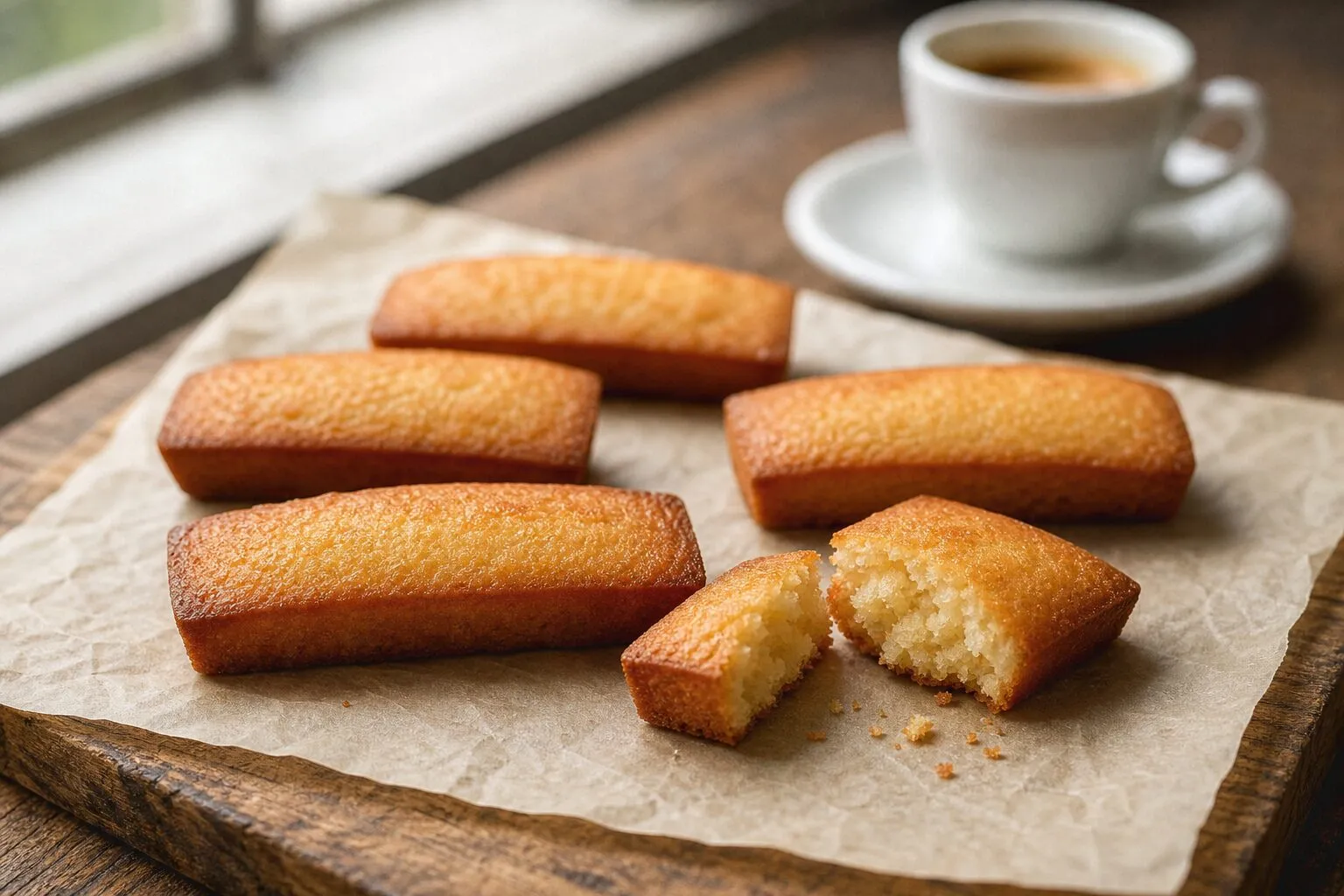
Financiers are small French cakes made with almond flour, egg whites and browned butter. Baked in rectangular molds, they come out crisp and toasty at the edges and moist inside, with the nutty aroma of browned butter.
You simply weigh the ingredients, mix them, fill the molds and bake: no whipping and no rising. This recipe was worked out by comparing five French recipes, including those of Paris pastry chef Hugues Pouget and the chef at a French baking-supply shop, and written as steps you can follow in a home oven.
What is a financier?
The name is the French word for a financier or capitalist. French Wikipedia describes it as a small oval or rectangular cake made with almond flour and egg whites. Gault&Millau, the French restaurant guide, gives its basic ingredients as butter, almond flour, wheat flour, sugar and egg whites.
A convent cake, and a pastry chef near the stock exchange
The origin story most often told comes in two parts.
The first is set in a 17th-century convent. On the website of the radio station Europe 1, Olivier Poels writes that in 17th-century Lorraine, an almond-flour cake made by nuns in a convent, the visitandine, enjoyed a certain popularity. Gault&Millau also writes that the cake was born in a 17th-century convent and was called visitandine after it. French Wikipedia, citing a local newspaper article, says that in the 17th century, in the city of Nancy in Lorraine, nuns of the Order of the Visitation (the Visitandines) made small cakes from almonds, flour, sugar, butter and egg whites. Its explanation of why they made them, however, carries a “citation needed” note.
The second is set in Paris around 1890. Poels and Gault&Millau say that a pastry chef named Lasne, whose shop was near the Paris stock exchange, took up the recipe. E-Santé, a French health website, says the cake was created around 1890 by Lasne, whose shop was near the stock exchange. Poels writes that Lasne changed the cake into the shape of a gold bar and named it after his customers, the financiers, and that those customers liked a cake that didn’t dirty their fingers. Gault&Millau likewise says the gold-bar shape was a nod to his financier customers. On the origin of the name, E-Santé gives two theories, that it was made so that financiers at the stock exchange could eat it without dirtying their hands, and that the rectangular mold recalls a gold bar, and says nobody knows for sure.
What the records show
French Wikipedia casts doubt on the Lasne story. What appears to be the oldest record of the name is a book published in 1865 by the pastry chef Pierre Lacam. It has recipes for a financier, an almond cake baked in a flat fluted mold, and for financières, baked individually in small savarin molds. Wikipedia says the story that Lasne came up with the name in the 1890s does not fit this record.
In a book from 1900, Lacam presents a large fruit-filled financier as a cake from Lasne’s shop on rue Saint-Denis, but gives no year. According to Wikipedia, sources of the time show a pastry chef named P. Lasne (also spelled Lasnes) running a shop on that street from about 1828 to 1850. It also points out that the stock exchange had been housed in the Palais Brongniart since 1826, and that rue Saint-Denis is not right beside it. Wikipedia says details such as the gold-bar shape should be treated with caution, since there are no historical documents to back them up.
The ratios in this recipe
In the five French recipes read for this article, the sugar weighs about the same as the egg whites, from 90% to about 1.1 times their weight. In the four that don’t use hazelnuts, the almonds weigh a third to a half as much as the egg whites, and the flour about a third. The butter varies widely, from half to about 90% of the weight of the egg whites.
This recipe uses 120 g egg whites, 120 g powdered sugar, 50 g almond flour, 40 g flour and 90 g butter. It uses a little more almond than flour to match French Wikipedia’s explanation that financiers replace more than half of the flour with almond flour. Only two of the five recipes use baking powder, and it isn’t among the basic ingredients given by Wikipedia or Gault&Millau, so this recipe leaves it out. Resting the batter in the fridge for 2 hours follows Pouget’s recipe.
The two French recipes that give mold sizes both use silicone molds, about 8.7 × 4.7 cm (3⅜ × 1⅞ in) and 9.5 × 4.5 cm (3¾ × 1¾ in). This recipe uses metal molds of about 8.4 × 4.2 cm (3¼ × 1⅝ in), which are 10–20% smaller in area than those, so the batter for each financier has been scaled down by the ratio of the areas, to about 34 g (1¼ oz).
Financier recipe: ingredients
Makes: 12 financiers, in molds about 8.4 × 4.2 cm (3¼ × 1⅝ in)Prep: 2 hr 40 min (including resting the batter in the fridge for 2 hours)Bake: 12–15 minutesDifficulty: Easy
Batter
- Unsalted butter (to be browned)90 g (about 6½ tbsp)
- Powdered sugar (not the non-melting kind sold for decorating)120 g (1 cup)
- Almond flour (blanched (skinless))50 g (½ cup)
- All-purpose (plain) flour (in place of the French T55 wheat flour)40 g (about ⅓ cup)
- Salt1 g (scant ¼ tsp)
- Egg whites (at room temperature)120 g (from 3–4 large eggs)
Preparing the molds
- Unsalted butter (softened at room temperature)10 g (about 2 tsp)
Equipment
- Financier molds (metal, about 8.4 × 4.2 cm (3¼ × 1⅝ in) and 1–1.2 cm (about ½ in) deep, for 12 financiers. With a 6-cavity mold, bake in 2 batches)
- Small saucepan (with a light-colored interior, so you can see the color change)
- Cooking thermometer (to check the temperature of the browned butter)
- Digital scale (accurate to 0.1 g (for weighing the salt))
- Sifter or sieve
- Whisk
- Rubber spatula
- Piping bag (or use a spoon)
- Pastry brush
- Wire rack
Method
Butter the molds
Brush 10 g (about 2 tsp) softened butter thinly inside the 12 molds, right into the corners. If you are using a 6-cavity mold, use half, 5 g (1 tsp), and keep the other 5 g (1 tsp) for the second batch. Put the molds in the fridge to chill.
Brown the butter
Put 90 g (about 6½ tbsp) butter in a small saucepan over medium heat. When the melted butter foams and crackles, its water is evaporating. Keep heating, swirling the pan now and then. Once the crackling dies down, the butter browns quickly, so don't take your eyes off it from here on. When the specks that have settled on the bottom are hazelnut brown and it smells toasty, transfer it straight into a heatproof bowl. Left in the pan, it will burn in the residual heat. Hot butter can spatter, so be careful not to burn yourself and keep your face away. If the specks turn black, it has gone too far.
Cool the browned butter
Let it stand for 15–20 minutes, until a cooking thermometer reads 40–50°C (105–120°F). The brown specks on the bottom carry flavor too, so don't strain them out; use them as they are.
Combine the dry ingredients
Sift 120 g (1 cup) powdered sugar, 50 g (½ cup) almond flour and 40 g (about ⅓ cup) flour into a bowl. Add 1 g (scant ¼ tsp) salt and mix everything with a whisk.
Mix in the egg whites without whipping
Make a well in the center of the dry ingredients and add 120 g egg whites. Move the whisk in small circles inside the well, drawing in the surrounding dry ingredients gradually from the inside out, until smooth. The key is to mix without whipping, so no air gets in.
Add the browned butter
Add the browned butter, cooled to 40–50°C (105–120°F), in 3 additions. Each time, whisk until the whole batter is glossy.
Rest in the fridge
Press plastic wrap directly onto the surface of the batter and refrigerate for 2 hours.
Fill the molds
Preheat the oven to 200°C (390°F). Stir the batter lightly with a rubber spatula until smooth and put it in a piping bag. Pipe about 34 g (1¼ oz) into each chilled mold, filling it about four-fifths full. If you are using a 6-cavity mold, keep the remaining batter in the fridge. When the first batch is baked, wash the mold, let it cool, prepare it as in step 1 with the remaining 5 g (1 tsp) butter, and bake the second batch.
Bake
Bake at 190–200°C (375–390°F) for 12–15 minutes. They are done when the edges are a deep golden brown, the centers have risen and the tops are lightly colored, they spring back when pressed lightly with a finger, and a skewer inserted in the center comes out clean.
Unmold and cool
The molds and the baking sheet are very hot, so take them out wearing oven mitts. Leave them on a wire rack for 2–3 minutes, then turn the molds upside down to release the financiers and let them cool on the rack.
Eat them with coffee or tea while the edges are still crisp. French Wikipedia also says that crème anglaise (a thickened sauce of egg yolks, milk and sugar), which you can make with the leftover yolks, goes with them best (with a “citation needed” note). If you make crème anglaise, cook it until it thickens so the yolks aren’t left raw.
The food science: browned butter (beurre noisette)
First the water boils off, then the milk solids brown
In French, browned butter is called beurre noisette, “hazelnut butter.” According to the American food media company Milk Street, butter is 80–84% milk fat and 14–18% water, and the rest is milk solids (proteins, sugars and so on).
America’s Test Kitchen, the American cooking research organization, explains that when butter is heated, the mixture of fat and water (an emulsion) breaks and the water separates out. The foaming and crackling are a sign that this water is evaporating. Once the water is gone, the temperature climbs above 100°C (212°F), and the sugars and amino acids in the milk solids react to create a brown color and a toasty aroma. This is the Maillard reaction. After the crackling dies down, the butter browns quickly, and it keeps browning in the residual heat even off the stove, which is why the steps tell you to transfer it straight to another bowl. Blackened specks taste bitter.
Because it loses water, browned butter weighs 10–20% less than the butter you started with. The 90 g butter in the ingredients is the weight before browning. There’s no need to top it up after browning.
Why the butter cools before it goes into the egg whites
A peer-reviewed paper reports that ovotransferrin, one of the proteins in egg white, denatures (changes shape with heat) at around 57°C (135°F). Adding hot, freshly browned butter to a batter containing egg whites is thought to risk setting some of the egg white. Pouget’s recipe cools the browned butter for 30 minutes, and the recipe from the baking-supply shop Meilleur du Chef also says to add it lukewarm. This recipe cools it to 40–50°C (105–120°F), while it is still liquid and easy to handle, before adding it.
Milk Street says that batters with other liquids, such as eggs, rely less on the water in the butter. In financier batter, the liquid comes from the egg whites.
The food science: unwhipped egg whites and almond flour
The egg whites form the structure
Egg white is about 9.7–12% protein, and most of the rest is water. According to a paper on egg white in a Brazilian agricultural journal, egg white starts to firm up at around 71°C (160°F), becomes elastic at 70–74°C (160–165°F) and forms a firm network at 85–90°C (185–195°F). Financiers contain little flour, so these egg-white proteins are thought to provide much of the structure that holds the cakes’ shape as they bake.
Whipping egg whites makes the proteins wrap around air bubbles, giving a light batter. Four of the five recipes read for this article mix in the egg whites without whipping them; only the recipe in the Europe 1 article whips them. Edward Behr of The Art of Eating, an American food magazine, writes that not whipping the whites is characteristic of this cake, and gives it a denser, springier texture. The steps have you move the whisk in small circles in the center so the batter mixes without lumps and without taking in air.
Almond flour keeps them moist
According to the French food composition table (Ciqual), 100 g of almonds with their skins contain 53.4 g fat and only about 0.4 g starch. When wheat flour is mixed with water, its proteins link up into an elastic network called gluten, but almonds form no gluten. More than half of the flour-like ingredients here are almond, which forms no gluten and is rich in fat, so the cakes are dense without being tough, and moist in the mouth.
Crisp edges
The batter contains as much sugar as egg white by weight. At the edges, where the batter touches the mold, the water evaporates quickly and the temperature rises, so the sugar and egg-white proteins brown into a crisp, toasty outside. The inside keeps its moisture and stays moist. According to a Gault&Millau article, Beurre Noisette, a pastry shop in Dijon, bakes only in metal molds to get both a distinct outside and a moist inside.
How French recipes differ
- Baking powder: the recipes from Meilleur du Chef and E-Santé add a small amount of baking powder.
- Whipped egg whites: the recipe in the Europe 1 article whips the egg whites before mixing them into the batter. Wikipedia also says there are both whipped and unwhipped methods.
- Hazelnuts: the recipe by French food blogger Julie, based on one by chef Cyril Lignac, replaces most of the almond flour with ground hazelnuts. Wikipedia also gives examples made with pistachios.
- Honey: Pouget’s recipe adds honey to the browned butter.
- Shapes and names: according to Wikipedia, visitandines are baked round or in a small boat shape. Some shops also sell financiers under the name friand.
Substitutions
- Metal financier molds: you can bake financiers in silicone molds too. The recipes from Meilleur du Chef and E-Santé use silicone molds, and Pouget’s recipe recommends them. Julie’s recipe bakes them in small muffin pans. Baking time changes with the mold, so judge doneness by the color and the skewer test in step 9, and bake longer if needed.
- Blanched almond flour: almond flour made from unpeeled almonds works at the same weight. The batter will be slightly darker, with the added flavor of the skins.
- Powdered sugar: Pouget’s recipe uses granulated sugar. You can use the same weight of granulated sugar instead.
- Unsalted butter: if you use salted butter, leave out the 1 g salt in the ingredients (this recipe’s guideline, to allow for the salt in the butter).
Troubleshooting
- The browned butter is black and bitter: it was heated too long. Once the crackling dies down, the color deepens suddenly. Transfer it to a bowl as soon as it is hazelnut brown. If there are a lot of black specks, it’s safer to start again.
- The edges are pale and not crisp: the oven temperature or the baking time was probably too low. Preheat thoroughly and bake until the edges are a deep golden brown. Silicone molds can brown the edges less than metal ones.
- The centers sink or are underdone: the baking time was too short. Bake until the centers have risen and spring back when pressed, and check with a skewer.
- The financiers stick in the molds: too little butter in the molds makes sticking more likely. Brush it thinly right into the corners, then chill. E-Santé says to unmold them while hot.
Storage
- Room temperature: once cooled, put them in an airtight container and keep them in a cool, dry place. E-Santé also recommends storing them somewhere dry. The crisp edges soften as the days go by, so eat them soon.
- Freezing: wrap each cooled financier in plastic wrap, put them in a freezer bag and freeze. The texture and flavor fade over time, so eat them soon. Thaw at room temperature before eating.
- Batter: the batter uses raw egg whites, so bake rested batter the same day.
More from France
Sources
- Meilleur du Chef, “Financier” (French)
- E-Santé, “Recette des financiers” (French)
- Do It In Paris, “Les financiers ultra-gourmands d'Hugues Pouget” (French)
- Europe 1, “Le financier” (French)
- Recettes de Julie, “Financiers aux noisettes” (French)
- Gault&Millau, “Le financier, son histoire et nos bonnes adresses” (French)
- Gault&Millau, “Où acheter un bon financier ?” (French)
- Wikipédia, “Financier (pâtisserie)” (French)
- informationsnutritionnelles.fr (Ciqual 2013), “Amande” (French)
- America's Test Kitchen, “Browned Butter Is a Cook's Secret Weapon” (English)
- Milk Street, “When to Use Browned Butter in Your Baking (and When to Skip It)” (English)
- Scientia Agricola, “Albumen protein and functional properties of gelation and foaming” (English)
- The Art of Eating, “Le Financier” (English)
The text and recipe were put together independently after comparing the sources above.