Galette BretonneRecipe
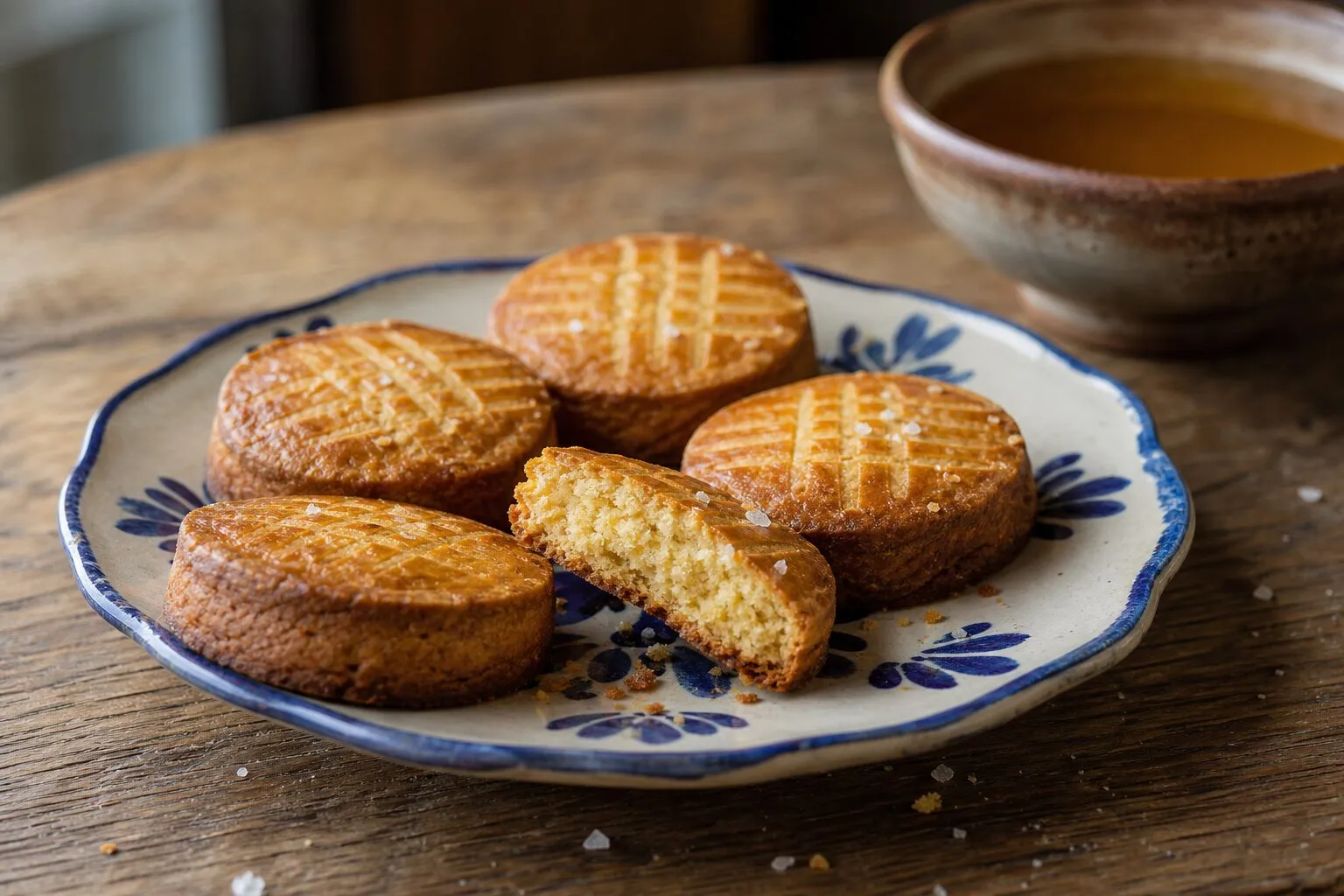
The galette bretonne is a butter cookie from Brittany, made with plenty of salted butter and egg yolks. This recipe bakes it thick, in rings. In France, this thick version is more often called a palet breton or sablé breton. Despite the shared word “galette,” it is not the same thing as Brittany’s savory galettes, the thin buckwheat crêpes folded around egg or ham.
The outside is crisp and toasty, and the inside crumbles. The salt in the butter balances the sweetness. This recipe is built around a chef’s recipe from Meilleur du Chef, a French online shop for baking supplies, compared with recipes from Brittany’s regional tourism board and French food writers, and turned into steps for baking thick cookies in pastry rings (bottomless metal rings, called cercles in French).
What is a galette bretonne?
In French it is written galette bretonne. A galette is a flat, round cake or bread, and bretonne means “from Brittany.” Because the same name is also used for buckwheat galettes, French Wikipedia titles its article on this cookie with the qualifier “biscuit.”
When it is baked thick in a mold, as in this recipe, it is often called palet breton or sablé breton in France. The naming is explained in more detail below, under “Galette or palet?”
A cookie from Pont-Aven
French Wikipedia names Pont-Aven, in the Finistère department at the western tip of Brittany, as its birthplace. In 1890, the town’s baker Isidore Penven is said to have created a small golden biscuit made with salted butter. Wikipedia says he took his inspiration from sablés and gâteau breton (Brittany’s butter cake), which were popular in the 1860s.
After Penven died, his widow married Alexis Le Villain. According to Wikipedia, Le Villain created the “palet” in 1920, inspired by the galette. Both the galettes and the palets were sold under the name Traou Mad, which means “good things” in Breton, and today many biscuit factories in Brittany make them, Wikipedia explains.
The local Concarneau–Pont-Aven tourist office also says the palets and galettes of Pont-Aven have been part of the town’s food heritage since 1890. It also says that Le Villain created the Traou Mad palet in 1920, which matches Wikipedia.
The details differ a little, though. The tourist office writes that the work was originally done by local bakers and that Penven took it over in 1890. It does not say that he was the first to make it. It also says that the Galette de Pont-Aven, a registered Traou Mad product, was created in 1950 by Le Villain’s daughter Marguerite. This reads as the start of a branded product, separate from the origin of the cookie itself. The sources describe who first made the cookie in different ways, so it can’t be stated for certain.
France.fr, the French national tourism website, says the craftspeople at the biscuit factories have applied for Protected Geographical Indication (PGI, or IGP in French, a scheme that protects regional product names). French Wikipedia says an application has been pending for both the galette and the palet since 2012. Whether it has been granted could not be confirmed in the sources read for this article.
Galette or palet?
On the name palet breton, France.fr explains that the cookie’s shape resembles the metal discs thrown in palet, a traditional Breton game. Brittany’s tourism board’s recipe also presents palets as golden, thick cookies. The Concarneau–Pont-Aven tourist office describes the Traou Mad palet as generous and substantial, and the Galette de Pont-Aven as golden and crisp.
Among the French recipes read for this article, the ones baked thick in rings or molds were called “palets” or “sablés bretons.” The ones cut out with a cookie cutter and baked directly on the baking sheet were called “galettes” or “sablés.” None of the recipes read called the thick version a “galette.” However, the description from the Pont-Aven maker that food writer Bernard Laurance quotes calls Traou Mad thick galettes rich in butter and flavor. The naming is not strict. This article uses the name galette bretonne and bakes the thick shape that in France would usually be called a palet breton.
The ratios in this recipe
The Meilleur du Chef recipe uses 125 g sugar, 125 g butter, 60 g egg yolks and 8 g baking powder for every 175 g flour. The recipe by food writer Mercotte has similar proportions of sugar, butter and yolks to flour. Meilleur du Chef adds salt to unsalted butter, but most of the other recipes use Breton lightly salted butter (demi-sel). This recipe uses salted butter. Mercotte’s recipe adds a pinch of fleur de sel (coarse sea salt) on top of the demi-sel butter, and following that, this recipe adds 1 g.
Bernard Laurance writes that Traou Mad in Pont-Aven are baked in 5.5 cm (2⅛ in) rings. This recipe uses 6 cm (2⅜ in) rings, so each cookie has about 1.2 times the area, and the recipe makes slightly fewer cookies.
Galette Bretonne recipe: ingredients
Makes: About 18 cookies (6 cm / 2⅜ in rings)Prep: 1 hr 30 min (including chilling the dough for 1 hour)Bake: About 1 hr 15 min (baking 6 at a time in 3 batches: 15–20 minutes per batch, plus time for the rings to cool)Difficulty: Moderate
Dough
- Egg yolks60 g (about 3 large egg yolks)
- Granulated sugar125 g (about ⅔ cup)
- Fleur de sel (coarse sea salt; ordinary salt also works)1 g
- Salted butter (the equivalent of Breton lightly salted butter (beurre demi-sel); softened at room temperature)125 g (about 1 stick plus 1 tbsp)
- All-purpose (plain) flour (in place of the French T55 wheat flour)175 g (about 1⅓ cups)
- Baking powder8 g (2 tsp)
Preparing the rings
- Salted butter (softened)5 g (1 tsp)
Equipment
- Pastry rings (at least 6 rings, 6 cm (2⅜ in) across and at least 1.5 cm (⅝ in) tall)
- Digital scale (one that reads to 0.1 g, for weighing the 1 g of salt)
- Whisk
- Rubber spatula
- Rolling pin
- Rolling guides (two 7 mm (just over ¼ in) thick bars, to roll the dough to an even thickness)
- Parchment paper (two sheets for rolling the dough, plus one to line the baking sheet)
- Fork (for scoring the tops (not needed if you skip the pattern))
- Small knife (to run around the inside of the rings when unmolding)
- Oven mitts
- Wire rack
Method
Get everything ready
Leave 125 g (about 1 stick plus 1 tbsp) salted butter and the 5 g (1 tsp) salted butter for the rings at room temperature until soft enough that a finger pressed into it sinks in easily. Don't melt it in the microwave or any other way. Sift 175 g (about 1⅓ cups) flour together with 8 g (2 tsp) baking powder.
Beat the yolks and sugar
Put 60 g (about 3 large) egg yolks, 125 g (about ⅔ cup) sugar and 1 g fleur de sel in a bowl and whisk for 2–3 minutes, until pale and thick.
Mix in the butter
Add the softened 125 g (about 1 stick plus 1 tbsp) salted butter and whisk until smooth.
Add the flour
Add the sifted flour and baking powder all at once and fold them in with a rubber spatula, using a cutting motion. Stop as soon as no dry flour remains and the dough comes together. Don't knead. The dough contains raw egg yolk, so don't taste it before baking.
Roll out to 7 mm (¼ in) and chill
Put the dough between two sheets of parchment paper, place 7 mm (just over ¼ in) rolling guides on either side, and roll it out to an even thickness with a rolling pin. Transfer it, still between the sheets, to a baking sheet or tray and refrigerate for at least 1 hour, until firm.
Prepare the rings and the oven
Preheat the oven to 180–190°C (355–375°F). With your fingers or a brush, coat the insides of the rings thinly with the softened 5 g (1 tsp) salted butter. It has to last for 3 batches, so use very little each time. Line a baking sheet with parchment paper.
Cut out the dough and arrange the rings
Peel the top sheet off the cold dough and press the rings into it to cut out rounds. Leave each round inside its ring and arrange them on the baking sheet at least 3 cm (1¼ in) apart. With the tips of a fork, score a shallow crosshatch pattern on top (this is optional). Put any dough waiting for the next batch back in the fridge. Gather up the scraps, roll them out again to the same 7 mm (just over ¼ in), chill for 20–30 minutes, then cut.
Bake
Bake at 180–190°C (355–375°F) for 15–20 minutes. The dough rises upward inside the rings. The cookies are done when the whole top is a deep golden brown and the edges are a little darker. If the center still looks pale, bake 2–3 minutes more at a time.
Unmold while warm
The baking sheet and rings are very hot, so take them out wearing oven mitts. Wait 2–3 minutes, then, while the cookies are still warm, run a knife all the way around the inside of each ring, press the cookie lightly from above and lift the ring off. Freshly baked cookies break easily, so move them gently to a wire rack and let them cool completely. Before the next batch, wait until the rings are cool enough to touch, then coat them thinly again with the remaining butter.
Brittany’s tourism board presents palets as perfect for the goûter (the afternoon snack) or with coffee. They also go well with tea. You will have 3 egg whites left over; use them for financiers or other bakes.
The food science: why so many egg yolks
Less water from egg whites, less gluten
According to Japan’s Standard Tables of Food Composition, 100 g of egg yolk contains about 50 g water and about 34 g fat. Egg white, on the other hand, is about 88 g water and contains almost no fat.
When the proteins in wheat flour get water and are kneaded, they link up into an elastic network called gluten. Bread needs it, but in this cookie, the more of that network forms, the harder and tighter the texture becomes. Using only yolks instead of whole eggs puts less water and more fat into the dough. There is also about as much sugar as butter, and sugar holds on to water, which makes gluten even less likely to form. That is why the baked cookies are crisp and light and crumble in your mouth. Mixing without kneading in step 4 also keeps gluten from developing.
Yolks bind the dough and brown it
Egg yolks contain lecithin and other emulsifiers, which help water and fat mix. If you beat the yolks and sugar well in step 2 before adding the butter, the butterfat spreads smoothly through the dough and is less likely to separate.
When baked, the proteins in the yolks and the sugars in the dough undergo the Maillard reaction, in which amino acids from proteins react with sugars under heat to create color and flavor. Dough with plenty of yolk bakes to a deep golden surface.
The food science: why bake in rings
Butter-rich dough spreads
The butter in this dough weighs about 70% as much as the flour. In the oven, the butter melts and the dough softens before the egg proteins have set with the heat. Add the gas from the baking powder, and without a mold the dough spreads out sideways and bakes thin and flat.
A recipe from Demotivateur, a French web magazine, bakes palets in pastry rings or muffin tins so they don’t spread during baking. The Meilleur du Chef chef also explains that because the mold holds the dough, the cookies all come out the same shape. Inside a ring, the dough can’t escape sideways, so it rises upward into a thick cookie with straight sides.
Chill before cutting, unmold while warm
Chilling the rolled dough in the fridge firms up the softened butter again. Cold dough cuts cleanly with the rings, and it melts and spreads more slowly at the start of baking.
Mercotte’s recipe unmolds the cookies right after baking, while they are still soft, by running a knife around them. This is probably because the butter and sugar harden as they cool, which makes the cookies more likely to stick to the rings. Freshly baked cookies break easily, though, so this recipe waits 2–3 minutes before unmolding.
Breton salted butter
According to Que Choisir, the magazine of a French consumer association, butter with 0.8–3 g salt per 100 g is called demi-sel (lightly salted) in France, and butter with 3 g or more is called salé (salted). Butter with no added salt (or less than 0.5 g per 100 g) is called doux (literally “sweet”). The magazine explains that butter was originally salted to preserve it. Most of the French recipes used as references for this article use demi-sel butter.
The salt amount in this recipe assumes salted butter with 1.9 g salt per 100 g, the figure Japan’s Standard Tables of Food Composition gives for salted butter, which falls within the French demi-sel range. Salted butters vary in salt content from brand to brand, so check the label. If your butter has less than 1.5 g salt per 100 g, increase the fleur de sel you add to 1.5 g.
Salt balances the sweetness and brings out the flavor of the butter. With coarse fleur de sel, the grains that don’t fully dissolve give little bursts of saltiness here and there.
Substitutions
- Breton demi-sel butter: use salted butter. As explained in the section above, salted butter with about 1.9 g salt per 100 g falls within the demi-sel range. If you only have unsalted butter, use 125 g (about 1 stick plus 1 tbsp) unsalted butter and increase the fleur de sel to 3.5 g. (125 g salted butter contains about 2.4 g salt; add the extra 1 g and you get about 3.4 g, rounded up.)
- Fleur de sel: use the same weight of ordinary salt. Its finer grains blend evenly into the dough.
- French T55 flour: use all-purpose (plain) flour.
- French baking powder (levure chimique): use the same weight of baking powder.
- Pastry rings: some French recipes bake these cookies in muffin tins or tartlet pans. Butter the tin, put the cut-out dough flat in the bottom, and bake. A tin of a different size changes the thickness, so judge the baking time by the color.
Troubleshooting
- The dough is sticky and won’t roll out or cut cleanly: the butter may have started to melt, or the room may have been too warm. Brittany’s tourism board’s sablé recipe also says the butter should only be softened, never melted. Chill the dough again in the fridge, still between the sheets.
- Dough leaks out from under the rings and loses its shape: the dough may have warmed up. Bake right after cutting, or chill the rings on the baking sheet in the fridge before baking. If the baking sheet isn’t flat, dough can also run out through the gap under the rings.
- The outside is dark but the inside is underbaked: the oven may have been too hot. Next time, lower it by 10°C (18°F) and bake longer.
- The cookies break or stick when you unmold them: they break if they are too hot and stick if they have cooled too much. Wait 2–3 minutes, then run a knife around them while they are still warm. Too little butter on the rings also makes sticking more likely.
Storage
- Room temperature: once they are completely cool, store them in an airtight tin or container, away from humidity. The Meilleur du Chef chef also says they keep well. This recipe’s guideline is 1 week.
- If they go soft: as a guideline from this recipe, warming them for a few minutes in an oven at about 150°C (300°F) and letting them cool on a rack brings back some of the crispness. Watch them so they don’t burn.
More from France
Sources
- Meilleur du Chef, “Sablés breton” (French)
- Mercotte, “Minis entremets aux fraises sur sablé breton” (French)
- La Cuisine de Bernard, “Traou Mad de Pont Aven, ma recette” (French)
- Tourisme Bretagne, “Palets bretons” (French)
- Tourisme Bretagne, “La recette des sablés bretons” (French)
- Demotivateur, “Cette recette de palets bretons traditionnels va enchanter vos papilles !” (French)
- Demotivateur, “Réalisez des galettes bretonnes au beurre salé !” (French)
- Meilleur du Chef, “Galette bretonne” (French)
- Wikipédia, “Galette bretonne” (French)
- De Concarneau à Pont-Aven, “Biscuiterie Traou Mad” (French)
- De Concarneau à Pont-Aven, “Biscuit factories in Pont-Aven” (English)
- France.fr, “À vos fourneaux : 4 goûters aux saveurs de la Bretagne” (French)
- Que Choisir, “Comment choisir son beurre” (French)
- Food Composition Database (MEXT, Japan), “無発酵バター 有塩バター(日本食品標準成分表(八訂)増補2023年)” (Japanese)
- Food Composition Database (MEXT, Japan), “鶏卵 卵黄 生(日本食品標準成分表(八訂)増補2023年)” (Japanese)
- Food Composition Database (MEXT, Japan), “鶏卵 卵白 生(日本食品標準成分表(八訂)増補2023年)” (Japanese)
The text and recipe were put together independently after comparing the sources above.