CastagnaccioRecipe
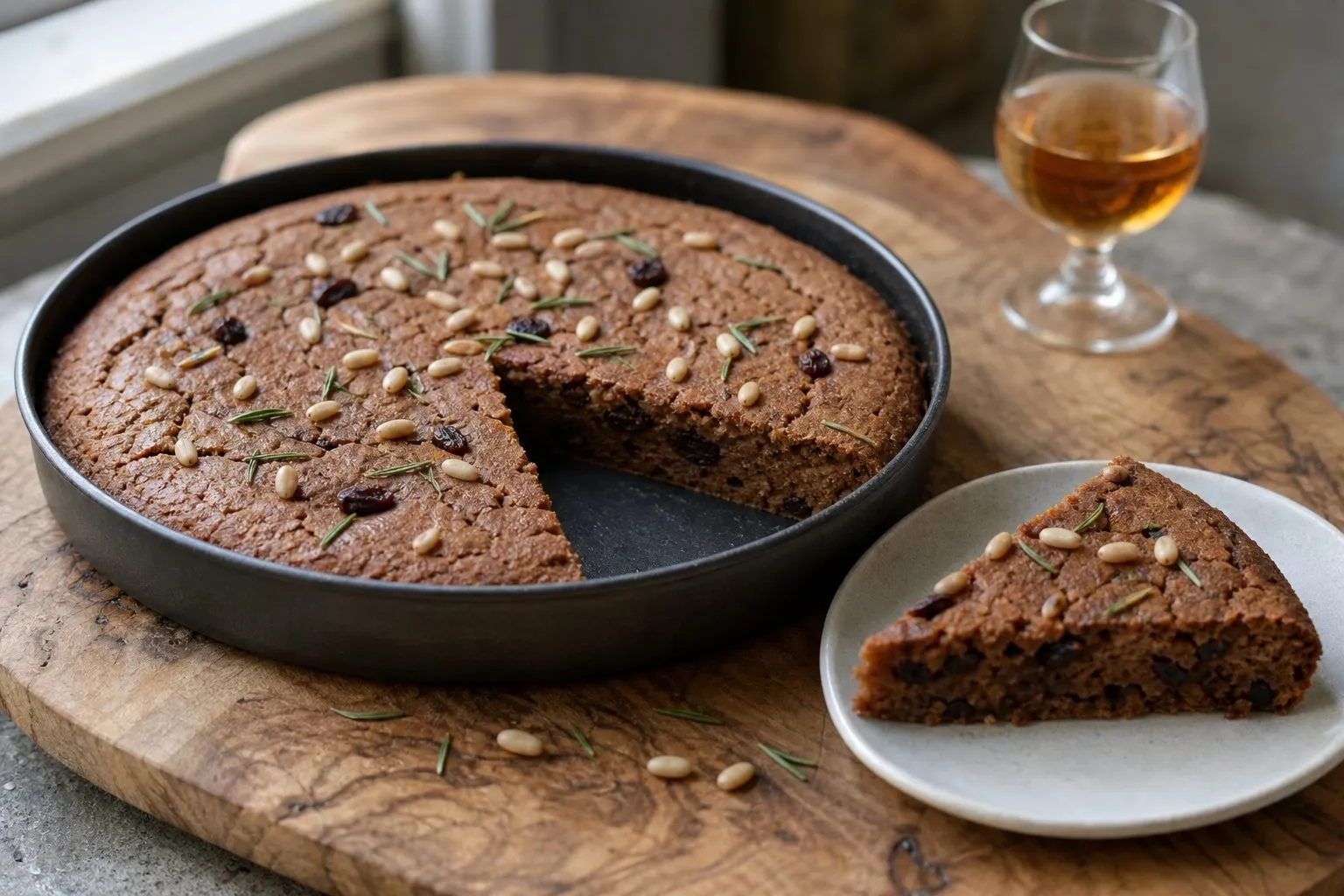
Castagnaccio is a Tuscan bake made from chestnut flour mixed with water, drizzled with olive oil and baked. It has no eggs, no butter, no raising agent and no added sugar. The sweetness comes from the chestnut flour itself. Pine nuts and rosemary leaves are scattered over the top, and the surface cracks finely as it bakes.
It is a simple, rustic cake from the mountain villages where chestnuts were close to a staple food. This recipe is based on the Tuscan-style formula from the Italian food website Dissapore, with the quantities adjusted for a 21 cm (8¼ in) round pan.
What is castagnaccio?
The name comes from castagna, the Italian word for chestnut.
Mountain villages where the chestnut was the “bread tree”
In the villages of the Apennine mountains, stretching from Tuscany into Emilia-Romagna and Liguria, chestnuts were a food people lived on. The Italian food magazine Il Cucchiaio d’Argento says that even when grain was scarce, dried and ground chestnuts gave a nourishing flour, so in mountain areas the chestnut tree was also called the “bread tree.”
In the Garfagnana, a mountainous area in the province of Lucca, chestnuts are dried in small huts called metati (singular metato). Chestnut wood is left to smolder without flames, and the rising smoke slowly dries the chestnuts over about 40 days. According to Tuscany’s official tourism website, until the 1950s the area had more than 7,000 metati and about 250 mills grinding the dried chestnuts. The chestnut flour made here is called farina di neccio (neccio is the local word for the chestnut tree), and it is now protected by a DOP (Protected Designation of Origin).
According to Italian Wikipedia, castagnaccio was largely forgotten for a while after the Second World War, as people became better off. It was later rediscovered, and today it is the star of autumn chestnut festivals.
Pilade of Lucca, said to be the first to make it
An early record often cited in connection with castagnaccio is the Commentario delle più notabili et mostruose cose d’Italia (“Commentary on the most notable and astonishing things of Italy”), written in the mid-16th century by the humanist Ortensio Lando (also spelled Landi). According to Italian Wikipedia, the book’s appendix, Catalogo dell’inventori delle cose che si mangiano (“Catalogue of the inventors of things to eat”), says that Pilade of Lucca was the first to make “castagnazzi” and was praised for it. The appendix is attributed to “an anonymous citizen of Utopia.” Sources disagree on the year the book came out, giving 1547, 1553 and other dates.
Writers also differ on where castagnaccio was born. Il Cucchiaio d’Argento says it originated in the Garfagnana, where chestnuts were a staple, and spread to central and northern Italy. Dissapore’s Tuscan-style recipe says it seems to have been made in Tuscany as early as the 16th century, and that it reached northern Italy in the 19th century, when raisins, pine nuts, rosemary and sugar were added. An article from the Italian food publisher Gambero Rosso, on the other hand, says it was originally made with just four ingredients, chestnut flour, water, oil and rosemary, and that pine nuts and raisins came later.
Artusi’s recipe
Castagnaccio also appears as recipe 240 in Pellegrino Artusi’s cookbook La scienza in cucina e l’arte di mangiar bene (Science in the Kitchen and the Art of Eating Well), under the title “Migliaccio di farina dolce volgarmente detto castagnaccio” (“migliaccio of sweet flour, commonly called castagnaccio”). Artusi gradually adds 800 ml (8 dl) cold water to 500 g chestnut flour to make a loose batter, then adds a handful of pine nuts. He notes that some people add walnuts, raisins or rosemary. The batter should be about a finger and a half thick; the pan is lightly oiled on the bottom, 2 tablespoons of oil go over the top, and it is baked and served hot.
Castagnaccio recipe: ingredients
Makes: One 21 cm (8¼ in) round cake (8 slices)Prep: 20 minutesBake: 30–35 minutes (then at least 30 minutes cooling)Difficulty: Easy
To prepare
- Raisins50 g (1¾ oz)
- Warm water (for soaking the raisins)100 ml (about 7 tbsp)
- Olive oil (extra virgin)27 g (2 tbsp)
- Fresh rosemary (warmed in the oil to flavor it, then removed)1 sprig (about 10 cm / 4 in long)
For the pan
- Olive oil (extra virgin)7 g (1½ tsp)
Batter
- Chestnut flour (farina di castagne in Italian)230 g (8 oz)
- Salt1 g (scant ¼ tsp)
- Water275 ml (about 1⅛ cups)
- Water, for adjusting the consistency (only if needed)30 ml (2 tbsp)
- Pine nuts20 g (¾ oz)
Topping
- Pine nuts10 g (⅓ oz)
- Fresh rosemary leaves (from one 10 cm (4 in) sprig)1 g
- Olive oil (extra virgin)14 g (1 tbsp)
Equipment
- 21 cm (8¼ in) round pan (not loose-bottomed: the batter is runny and would leak out of a pan with a removable base. A low-sided metal pan works well.)
- Small saucepan
- Bowls (2 (one for the raisins, one for the batter))
- Sieve (for sifting the flour)
- Whisk
- Rubber spatula
- Pastry brush (for oiling the pan)
- Skewer
- Digital scale (to weigh the 1 g of salt and 1 g of rosemary leaves)
- Thick oven mitts
- Wire rack
Method
Soak the raisins
Put 50 g (1¾ oz) raisins in a bowl, pour over 100 ml (about 7 tbsp) warm water and leave for 10 minutes.
Infuse the oil with rosemary
Put 27 g (2 tbsp) olive oil and the rosemary sprig in a small saucepan and warm over very low heat for 2–3 minutes. When small bubbles form around the sprig and it smells fragrant, turn off the heat. Don't heat it until it smokes. The moisture in the fresh sprig can make the oil spit, so keep your face away. Let it cool as it is, then remove the sprig.
Prepare the pan and preheat the oven
Brush 7 g (1½ tsp) olive oil evenly over the bottom and sides of the pan. Preheat the oven to 180–190°C (355–375°F).
Sift the flour
Set the sieve over the batter bowl and sift in 230 g (8 oz) chestnut flour and 1 g (scant ¼ tsp) salt. Chestnut flour often forms clumps in the bag, so press any lumps left in the sieve through with your fingers.
Add the water in stages
Add about 90 ml (6 tbsp) of the 275 ml (about 1⅛ cups) water and work it in with the whisk to a smooth paste with no lumps. Add the rest of the water in 3 additions, mixing well each time. Aim for a batter that falls from the whisk in a thick ribbon, with the trail disappearing almost at once. If the trail stays and the surface doesn't level out, add the extra 30 ml (2 tbsp) water 1 tbsp (15 ml) at a time, mixing after each addition. Add the cooled rosemary oil and mix until it is evenly combined.
Mix in the raisins and pine nuts
Squeeze the raisins lightly in your hand to drain them. Add about 70% of them (35 g / 1¼ oz, weighed before soaking) and 20 g (¾ oz) pine nuts to the batter and fold in with a rubber spatula.
Pour into the pan and add the topping
Pour the batter into the pan and shake the pan gently to level the surface. Scatter over the remaining raisins (15 g / ½ oz, weighed before soaking), 10 g (⅓ oz) pine nuts and 1 g rosemary leaves, then drizzle 14 g (1 tbsp) olive oil over the whole surface.
Bake
Bake on the middle rack at 180–190°C (355–375°F) for 30–35 minutes. It is done when the top is dry and no longer shiny, fine cracks run across the whole surface, and the edges are dark brown and have pulled away from the pan by 2–3 mm (⅛ in). The center should feel soft but not sticky when pressed lightly with a finger, and a skewer inserted in it should come out without wet batter on it. For crisper edges, bake 5–10 minutes more, watching the color so the pine nuts don't burn.
Cool and slice
Take the pan out with thick oven mitts and set it on a wire rack. The pan and the oil on top are very hot, so don't touch them with bare hands. Leave it in the pan for at least 30 minutes, until it has set, then cut into 8 slices. You can eat it while still warm, but for clean slices, let it cool completely before cutting.
You can eat it warm or cooled. Italian Wikipedia suggests serving it with ricotta or chestnut honey, or with Vin Santo (a sweet Tuscan wine) or the year’s new wine (vino novello).
The food science: how a gluten-free batter sets
It doesn’t toughen however much you mix it
When you add water to wheat flour and mix, the wheat proteins link up to form gluten, a stretchy network. That is why wheat batters and doughs turn tough if you overmix them.
Chestnut flour doesn’t form gluten. Chestnut proteins don’t build a network the way wheat proteins do, and there is relatively little of them: about 6% in the chestnut flour analyzed in a doctoral thesis from a Spanish university. So the batter doesn’t toughen even when you whisk it hard. That is why, in step 5, you can mix as much as you need to get rid of every lump.
Dissapore says chestnut flour is sticky and sets on its own, so there is no need to add wheat flour or cornstarch.
Starch is what sets it
About half of chestnut flour is starch. A paper by Portuguese and Spanish researchers, citing earlier studies, gives its starch content as 50–60%. In the same paper, when chestnut flour was mixed with water at 30% concentration and heated, gelatinization began at around 60°C (140°F) and was complete at around 73°C (165°F). Gelatinization is when starch granules absorb water and swell, thickening the mixture. Raising the heating temperature or extending the heating time made the resulting gel (a jelly-like state) slightly firmer.
Castagnaccio contains no eggs and no raising agent. In the oven, the starch dispersed in the water gelatinizes, and the whole batter sets to a soft, slightly chewy texture. Because it doesn’t rise, the thickness of the batter in the pan is the thickness of the finished cake. Pour it thin and the edges turn crisp; pour it thick and it comes out moist and dense.
It firms up as it cools
As gelatinized starch cools, its molecules gradually pack together and it slowly firms up. Food scientist Harold McGee explains this change as starch retrogradation. Fresh from the oven, castagnaccio is soft and the cut slices crumble easily, but as it cools it sets and becomes easier to slice. That is why the recipes from Ricette dal Mondo and Il Cucchiaio d’Argento say to let it cool before serving. Artusi, on the other hand, says to serve it hot, and the recipe on Tuscany’s official tourism website says it is good warm or cold, so you can eat it either way.
The food science: why it’s sweet without sugar
Chestnut flour is 20–30% sugar
According to figures from earlier studies cited in the paper mentioned above, chestnut flour contains 20–32% sugars, mostly sucrose (the same compound as table sugar). The chestnut flour analyzed in the Spanish doctoral thesis contained 23.7%. That means the 230 g of chestnut flour in this recipe holds roughly 45–75 g of sugars, which is why it tastes sweet without any added sugar.
Dissapore recommends not adding sugar or honey, as chestnut flour is naturally sweet. The browning and toasty flavor of the top come partly from the Maillard reaction, in which sugars and proteins react with heat to create color and aroma. The Spanish doctoral thesis also found that adding sucrose shifted the temperature at which chestnut flour batter gelatinizes upward.
Rosemary flavor goes into the oil
According to McGee, many of the aroma compounds in herbs such as rosemary dissolve more readily in oil than in water. Warming the oil with rosemary over low heat in step 2 transfers the aroma into the oil, which then carries it through the whole batter. Dissapore’s Tuscan-style recipe uses the same method.
The oil drizzled over the top toasts the pine nuts and rosemary leaves, almost frying them in the oven. Dissapore cautions that you should use plenty of oil, but not so much that the batter is swimming in it. Oil heats up quickly, so do step 2 over very low heat and turn off the heat before the oil smokes.
Regional variations
According to Italian Wikipedia and Dissapore, even within Tuscany the name and thickness vary from place to place.
- Lucca: called torta di neccio, and baked thicker.
- Lunigiana (the far northwestern corner of Tuscany): a much thinner version called patona or castignà.
- Livorno: a dense version about 3 cm (1¼ in) tall is called toppone.
- Florence: migliaccio, or ghirighio on the plain around Florence.
- Arezzo: baldino.
The add-ins and flavorings vary too. Both recipes on Tuscany’s official tourism website include walnuts, and one of them soaks the raisins in warm water with Vin Santo added. Italian Wikipedia says some areas add orange peel or fennel seeds.
Some recipes add sugar. Il Cucchiaio d’Argento uses 60 g sugar for 300 g chestnut flour, and Ricette dal Mondo uses 20 g sugar (optional) for 250 g chestnut flour. Il Cucchiaio d’Argento itself writes that traditional castagnaccio is not very sweet, that sugar is a relatively recent addition, and that not every recipe includes it.
Substitutions
Chestnut flour
Chestnut flour is sold as chestnut flour or under its Italian name, farina di castagne.
- Choose one made only from chestnuts: some chestnut products sold for baking contain added sugar or flavorings. Check that the ingredient list says chestnuts only.
- Chestnut paste and cooked chestnuts won’t work: chestnut paste contains a lot of sugar, and roasted or cooked chestnuts haven’t been dried, so they hold much more water. In this recipe they would change both how the cake sets and how sweet it is.
- Don’t mix in wheat flour: topping up a shortfall of chestnut flour with wheat flour creates gluten and changes the texture. Dissapore also lists adding other flours as one of the mistakes to avoid.
- Color and flavor vary with origin: chestnut flour from the Garfagnana is said to range in color from white to deep ivory. Different flours absorb different amounts of water, so check the consistency in step 5 and adjust with the extra water.
- Refrigerate after opening: chestnut flour also contains a little fat (about 2.8% in the chestnut flour used in the paper by Portuguese and Spanish researchers). As it ages, the fat can go off and give unpleasant smells or bitterness. Once opened, seal it, keep it in the fridge and use it up soon.
Other ingredients
- Fresh rosemary: you can also use dried rosemary (Dissapore’s other recipe uses dried). In step 2, warm ½ tsp (about 0.5 g) dried rosemary in the oil, then strain it through a fine-mesh strainer. Scatter another ½ tsp (about 0.5 g) on top.
- Pine nuts: if you can’t get them, use the same weight of coarsely chopped walnuts (20 g / ¾ oz in the batter and 10 g / ⅓ oz on top). Some Tuscan recipes use walnuts too.
- Pan: you can bake the same quantities in a 20 cm (8 in) or 22 cm (8¾ in) round pan, or an 18 cm (7 in) square pan. The area changes by only about 10%, so in a larger pan, where the batter is thinner, allow about 5 minutes less baking time; in a smaller pan, where it is thicker, allow about 5 minutes more. Judge by the cracks and the skewer test. Don’t use a loose-bottomed pan, as the batter will leak.
All the ingredients are gluten-free, but chestnut flour is sometimes produced in the same facilities as wheat. If you are serving it to someone with a wheat allergy or celiac disease, check the label on the package. Pine nuts and walnuts are nuts, so take care with nut allergies too.
Troubleshooting
- Lumps in the batter: the flour wasn’t sifted, or the water went in all at once. Sift the flour, make a paste with a small amount of water first, then add the rest in stages. Strain out any remaining lumps through a sieve.
- Sticky and underdone inside: it wasn’t baked long enough, or there was too much water. Cutting it straight from the oven also makes the cut surface look sticky. Next time, check the cracks on top and use the skewer test, and let it cool before cutting.
- Hard, dry edges: it was overbaked, or the pan was too big and the batter too thin. In a pan larger than 21 cm (8¼ in), allow a shorter baking time.
- It sticks to the pan: there wasn’t enough oil in the pan. Coat the bottom and sides without leaving gaps. If your pan tends to stick, line the bottom with a circle of parchment paper.
Cracks on top are not a fault. Il Cucchiaio d’Argento also says they are a sign of a proper castagnaccio.
Storage
- Room temperature: once cooled, cover with plastic wrap and keep in a cool place for up to 3 days.
- Fridge: when the room is warm, keep it in the fridge, and bring it back to room temperature before eating.
More from Italy
Sources
- Dissapore, “Castagnaccio alla toscana” (Italian)
- Dissapore, “Castagnaccio” (Italian)
- Dissapore, “Castagnaccio: errori da non fare” (Italian)
- Ricette dal Mondo, “Castagnaccio, la ricetta tradizionale toscana” (Italian)
- Visit Tuscany, “La ricetta del Castagnaccio” (Italian)
- Visit Tuscany, “Castagnaccio recipe by Arturo Dori” (English)
- Il Cucchiaio d'Argento, “Castagnaccio” (Italian)
- Visit Tuscany, “La Farina di Neccio della Garfagnana DOP” (Italian)
- Wikipedia, “Castagnaccio” (Italian)
- Gambero Rosso, “Che cos'è il castagnaccio, la mattonella dolce che riempie i forni di Roma (e dove mangiarlo)” (Italian)
- doppiozero, “Castagno” (Italian)
- Food and Bioprocess Technology, “Thermorheological and Textural Behaviour of Gluten-Free Gels Obtained from Chestnut and Rice Flours” (English)
- Portal científico da Universidade de Vigo, “Thermorheological characterization of gluten-free doughs from chestnut flour” (English)
The text and recipe were put together independently after comparing the sources above.