Torta della NonnaRecipe
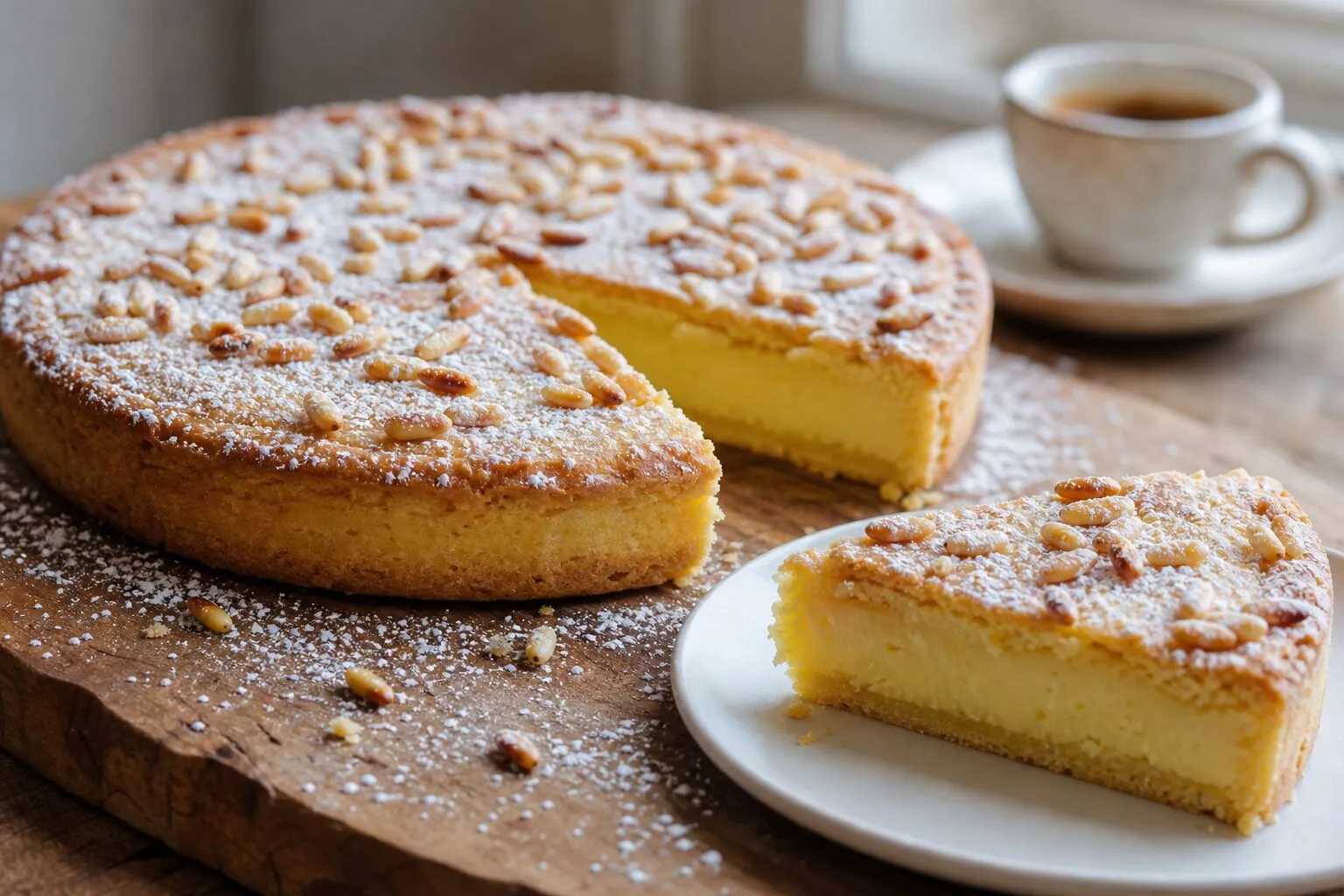
Torta della nonna is a Tuscan tart: lemon-scented custard sandwiched between two layers of crisp, sweet pastry, topped with pine nuts and baked. Finished with a dusting of powdered sugar, the toasty pine nuts and the gentle sweetness of the custard go together beautifully.
The ingredients are all everyday ones: flour, butter, sugar, eggs, milk, lemon and pine nuts. Both the pastry and the custard can be made ahead and chilled, so on baking day all you have to do is assemble the tart and bake it.
What is torta della nonna?
In Italian it is written torta della nonna. Torta means cake or tart, and nonna means grandmother, so the name means “grandmother’s tart.”
The pastry is pasta frolla, a cookie-like dough made with butter, sugar and eggs. The filling is crema pasticcera, a pastry cream of milk, egg yolks and sugar thickened with flour or another starch.
Arezzo or Florence?
The name suggests a home recipe handed down through families, but where and when it was born is not clear.
Italian Wikipedia gives two theories: that it has long existed around Arezzo, in eastern Tuscany, and that it was created more recently in Florence.
The story most often told for Florence involves Guido Samorini, a cook and restaurant owner. Regular customers, tired of the restaurant’s small choice of desserts, asked him to serve something surprising the following week. He served this tart, and it became a hit, or so the story goes. Italian writer Valeria Necchio, in an article on the British food website Great Italian Chefs, calls this the most credible version and names the restaurant as San Lorenzo.
However, the current page of Il Cucchiaio d’Argento, the food website that Italian Wikipedia cites as its source for this story, does not mention Samorini. It says the tart is a traditional Tuscan sweet that came from a cook’s idea of surprising customers with just a few ingredients. English Wikipedia also marks this story as “failed verification.”
Dissapore, an Italian food publication, tells a similar story as a legend: a restaurant owner in Arezzo, whose customers were tired of the usual desserts, promised to serve a new one a week later and came up with this tart. What the theories have in common is that the tart was created for restaurant customers.
Some people see an older form of it in the writing of Pellegrino Artusi, the author of a 19th-century cookbook. Dissapore presents it as a passage from Artusi’s 1891 book La scienza in cucina e l’arte di mangiar bene (Science in the Kitchen and the Art of Eating Well), while Necchio writes that Artusi tasted a similar dish on his travels around Italy. However, we have not been able to confirm in the original where in the book that passage appears.
GialloZafferano, a major Italian recipe website, describes it as a popular choice on restaurant dessert trolleys from the mid-1980s to the early 1990s.
With or without a top crust?
Of the six recipes by Italian writers consulted for this article, five use pasta frolla, and all five cover the filling with a second layer of pastry on top. GialloZafferano also shows a version without the top crust. Some, like Dissapore’s, use a pastry with no sugar or eggs and pour in a filling of eggs and cream, so the tart varies from home to home and from shop to shop.
A version made with cocoa and topped with almonds instead of pine nuts is called torta del nonno (“grandfather’s tart”).
For the pastry in this recipe, cold butter is rubbed into the flour, following the method of GialloZafferano, RicetteDalMondo and Necchio, and the proportions sit in the middle of the range used by RicetteDalMondo, Il Cucchiaio d’Argento and Necchio. The custard is thickened with flour, as in GialloZafferano and Necchio, and its proportions sit in the middle of the range used by RicetteDalMondo, Il chicco di mais (a GialloZafferano blog) and Necchio. Italian recipes use pans 20–26 cm (about 8–10 in) across, so the amounts here were scaled by area to fit a 21 cm (8¼ in) pan.
Torta della Nonna recipe: ingredients
Makes: One 21 cm (8¼ in) round tart pan with a removable base, 2.5–3 cm (1–1¼ in) deep (8 slices)Prep: 2 hr (including chilling the dough and the custard)Bake: 45–55 minutesDifficulty: Moderate
Preparing the pan and dusting
- Unsalted butter (for greasing the pan)10 g (about 2 tsp)
- All-purpose (plain) flour (for dusting the pan)10 g (about 1¼ tbsp)
- Bread flour (for dusting the work surface)30 g (about ¼ cup)
Pastry (pasta frolla)
- All-purpose (plain) flour (in place of Italian 00 flour; cake flour also works)250 g (2 cups)
- Baking powder2 g (½ tsp)
- Salt1 g (scant ¼ tsp)
- Unsalted butter (cold, straight from the fridge, cut into 1 cm (½ in) cubes)140 g (about 1¼ sticks / 10 tbsp)
- Granulated sugar110 g (about ½ cup plus 1 tbsp)
- Lemon zest, finely grated (from an unwaxed lemon; yellow part only)2 g (from ½ lemon)
- Egg (beaten and chilled)50 g (1 large egg)
Custard (crema pasticcera)
- Whole milk450 ml (about 1¾ cups plus 2 tbsp)
- Lemon peel (from an unwaxed lemon, white pith removed, cut into strips 2 cm × 6 cm (¾ × 2½ in))4 g (2 strips)
- Egg yolks72 g (4 large egg yolks)
- Granulated sugar90 g (about 7 tbsp)
- All-purpose (plain) flour36 g (about 4½ tbsp)
Topping
- Egg white (left over from the custard)15 g (1 tbsp)
- Pine nuts50 g (about 1¾ oz)
- Powdered sugar10 g (about 4 tsp)
Equipment
- Tart pan (metal, 21 cm (8¼ in) across and 2.5–3 cm (1–1¼ in) deep, with a removable base)
- Digital scale (reading to 0.1 g)
- Rolling pin
- Bench scraper
- Whisk
- Fine-mesh sieve
- Silicone spatula
- Heavy saucepan (16–18 cm (6–7 in) across)
- Shallow tray (for spreading out and chilling the custard)
- Pastry brush
- Small sieve or tea strainer
- Wire rack
Method
Rub the butter into the flour
Put 250 g (2 cups) flour, 2 g (½ tsp) baking powder and 1 g (scant ¼ tsp) salt in a bowl and mix. Add 140 g (about 1¼ sticks) cold butter and rub it into the flour with your fingertips until no pieces of butter are visible and the mixture looks like fine, dry sand. Work quickly so the heat of your hands doesn't melt the butter.
Bring the dough together and chill
Mix in 110 g (about ½ cup plus 1 tbsp) sugar and 2 g grated lemon zest. Add 50 g (1 large) beaten egg and mix with a bench scraper using a cutting motion. When it forms clumps, press it together by hand into one piece. Don't knead it. Divide it into two pieces of about 370 g (13 oz) and about 185 g (6½ oz), shape each into a disc 2 cm (¾ in) thick, wrap in plastic wrap, and refrigerate for at least 1 hour.
Prepare the pan
Brush the inside of the tart pan thinly with 10 g (about 2 tsp) butter, dust it with 10 g (about 1¼ tbsp) flour, and tap out the excess. Keep it in the fridge until you need it.
Infuse the milk with lemon
Put 450 ml (about 1¾ cups plus 2 tbsp) milk and 4 g (2 strips) lemon peel in a saucepan and heat over medium heat until just below boiling, when small bubbles appear around the edge. Take it off the heat, cover, and let it stand for 10 minutes.
Mix the yolks, sugar and flour
Whisk 72 g (4 large) egg yolks and 90 g (about 7 tbsp) sugar in a bowl until pale. Sift in 36 g (about 4½ tbsp) flour and mix until no dry flour is visible. Remove the lemon peel from the milk, then add the milk in 4–5 additions, mixing each time. Pour the mixture back into the saucepan through a fine-mesh sieve.
Cook the custard
Set over medium heat and whisk constantly, scraping the bottom and corners of the pan. Once it has thickened and become heavy and the center is bubbling, keep cooking and whisking for another 1–2 minutes. It is done when it turns glossy and feels slightly lighter to whisk. Boiling custard spatters and can burn you, so keep your face away and use a long whisk.
Cool the custard quickly
Spread it out on a shallow tray right away and press plastic wrap directly onto the surface. Set the bottom of the tray in ice water to take the heat out, then refrigerate for at least 1 hour, until it is cold all the way through.
Preheat the oven
Set an oven rack in the lower position and preheat the oven to 170–180°C (340–355°F).
Line the pan with the base
Dust the work surface and the dough with bread flour (from the 30 g / about ¼ cup). Roll out the larger piece of dough into a circle 27–28 cm (10½–11 in) across and 3–4 mm (⅛ in) thick. If it is hard and cracks straight from the fridge, let it stand for about 5 minutes before rolling. Roll it around the rolling pin, lift it onto the pan, and press it firmly into the bottom corners and up the sides. Roll the rolling pin over the rim to cut off the overhanging dough.
Fill with the custard
Loosen the cold custard with a silicone spatula until smooth, spoon it into the pastry case, and level the surface.
Put on the top crust
Combine the smaller piece of dough with the trimmings and roll it out into a circle 23 cm (9 in) across and 3 mm (⅛ in) thick. Lay it over the custard, press the edges with your fingers to seal them to the base, and cut off the overhanging dough.
Brush with egg white and add the pine nuts
Loosen 15 g (1 tbsp) egg white with a fork and brush a thin layer over the whole top. Scatter 50 g (about 1¾ oz) pine nuts evenly over it and press them in lightly with your palm. Chill the tart, still in its pan, in the fridge for about 10 minutes.
Bake
Bake on the lower rack at 170–180°C (340–355°F) for 45–55 minutes. If the top is browning too much at around 35 minutes, cover it loosely with foil. It is done when the top and edges are an even deep golden brown and the pine nuts are toasted light brown. The pan and the inside of the oven are very hot, so take the tart out wearing thick oven mitts.
Chill and finish
Leave the tart in its pan on a wire rack at room temperature for about 2 hours, until completely cool. Cover with plastic wrap and refrigerate for at least 6 hours (ideally overnight) so the custard sets. Unmold it and dust with 10 g (about 4 tsp) powdered sugar through a small sieve just before serving.
Take it out of the fridge 10–15 minutes before serving and enjoy the custard while it is still cool. It is lovely with an espresso after a meal.
The food science: why pasta frolla is chilled
Coating the flour with cold butter
When you mix flour with liquid, the proteins in the flour link up to form gluten, a stretchy network of protein. Bread can’t do without it, but in pasta frolla too much gluten makes the pastry tough and makes it shrink as it bakes.
Rubbing cold butter into the flour first coats the flour particles in fat, so that the moisture in the egg added later has a harder time reaching the proteins. Food scientist Harold McGee explains that fat cuts the gluten strands short, which makes pastry crumbly. This is where the English word “shortening” comes from.
If the butter is soft, it blends into the flour and turns sticky, and the dough stays limp even after the egg goes in. Kneading develops more gluten, so stop as soon as the dough comes together.
Resting makes it easier to roll and less likely to shrink
There are three reasons to chill the dough for at least 1 hour once it has come together:
- The butter firms up, so the dough can be rolled thin without sticking (GialloZafferano also says to chill the dough to firm it up).
- The moisture from the egg spreads through all the flour, so the dough is less likely to crack when rolled.
- The gluten tightened during mixing relaxes, so the pastry is less likely to shrink in the oven after you line the pan.
Chilling the tart again in its pan just before baking works the same way. When cold pastry goes into a hot oven, its surface sets before the butter has a chance to melt and run, so the sides are less likely to slump.
00 flour and what to use instead
Italian wheat flour is graded 00, 0, 1 and 2 according to its ash (mineral) content. Under Italian law (Presidential Decree No. 187 of 2001), 00 flour must have no more than 0.55% ash and at least 9.0% protein. Both figures are by dry weight; converted to a flour with 14.5% moisture, 9.0% protein comes to about 7.7%.
Pasta frolla is a dough in which you don’t want to develop gluten, so you don’t need 00 flour: it can be made perfectly well with a low-protein soft wheat flour such as cake flour. This recipe uses all-purpose (plain) flour, but cake flour also works.
The food science: starch and eggs in the custard
Why it doesn’t curdle when it boils
A custard set with eggs alone curdles into grainy lumps if it gets too hot, because the egg proteins set too firmly. That is why baked custards are cooked gently at a low temperature.
A custard made with flour stays smooth even when it boils. Starch granules start to absorb water and swell at roughly 60°C (140°F), and the custard thickens more and more as it approaches boiling (this is called gelatinization). McGee explains that this is because the starch gets in the way of the egg proteins binding tightly to one another.
Why it cooks for 1–2 minutes after boiling
Don’t take the custard off the heat as soon as it thickens. Egg yolks contain an enzyme, amylase, that breaks down starch. Food science books such as McGee’s explain that if the custard isn’t heated enough, the enzyme keeps working, breaking down the starch as the custard cools so that it turns thin and runny.
Cooking it for 1–2 minutes once the center is bubbling stops the enzyme and fully gelatinizes the starch. Don’t skip the boiling, either, because it also cooks the eggs thoroughly. This step, together with chilling the tart well in the fridge after baking, is what stops the custard from running out when you cut it.
GialloZafferano explains that pastry cream is often thickened with cornstarch, but that this tart uses flour because the custard is heated a second time in the oven. Some recipes, such as those from RicetteDalMondo and Il chicco di mais, do use cornstarch.
Why it is cooled quickly
A custard of egg yolks and milk is a food in which bacteria multiply easily if it sits at a lukewarm temperature for long. Spreading it thinly on a tray and cooling it over ice water gets it through that temperature range quickly. Pressing plastic wrap onto the surface also stops it from drying out and forming a skin.
It also matters that the custard is cold when it goes into the pastry. Warm custard melts the butter in the base, which then soaks up moisture from the custard, leaving the bottom sticky and underbaked-looking even after baking.
Substitutions
- 00 flour: a type of Italian wheat flour. All-purpose (plain) flour or cake flour works instead (see the food science section for why).
- Pine nuts: if you can’t get them, use the same weight of sliced almonds. Take care when serving it to anyone with a nut allergy.
- Lemon zest and peel: avoid lemons with skins treated with fungicide or wax; use untreated, unwaxed lemons. Leave out the white pith, which is bitter.
- An 18 cm (7 in) tart pan: its area is about 0.75 times that of a 21 cm (8¼ in) pan. Multiply all the ingredients by 0.75 and divide the dough into pieces of about 280 g (10 oz) and about 140 g (5 oz). Bake for about 40–50 minutes.
- A 24 cm (9½ in) tart pan: its area is about 1.3 times that of a 21 cm (8¼ in) pan. Multiply all the ingredients by 1.3 and bake for about 50–60 minutes.
Troubleshooting
- The base is sticky and seems underbaked: the custard was warm when you filled the tart, or there wasn’t enough heat from the bottom of the oven. Chill the custard all the way through before filling, bake on the lower rack, and use a metal pan.
- The pastry on the sides slid down during baking: the dough had warmed up and softened, or it was rolled thinner on the sides. Chill the lined pan in the fridge before baking, and make the sides as thick as the base.
- The custard runs out when you cut it: the custard wasn’t cooked long enough after boiling, or the tart wasn’t chilled for long enough. Cook it for 1–2 minutes after it boils, and chill the baked tart in the fridge for at least 6 hours.
- The pastry is tough and shrank in the pan: the dough was overworked, or it wasn’t rested long enough. Once you add the egg, stop mixing as soon as the dough comes together, and chill it for at least 1 hour.
Storage
- Fridge: 2 days, covered with plastic wrap. Because the custard contains eggs and milk, keep it in the fridge rather than leaving it at room temperature for long.
- Pastry dough: wrapped as in step 2, 2 days in the fridge or 1 month in the freezer. Thaw frozen dough in the fridge before using.
- Custard: made through step 7, it keeps in the fridge until the next day.
More from Italy
Sources
- GialloZafferano, “Torta della nonna” (Italian)
- RicetteDalMondo.it, “Torta della nonna cremosissima. La ricetta originale per farla perfetta!” (Italian)
- Il Cucchiaio d'Argento, “Torta della nonna” (Italian)
- Il chicco di mais (GialloZafferano Blog), “Torta della nonna classica” (Italian)
- Dissapore, “Torta della nonna, la ricetta originale con crema e pinoli” (Italian)
- Wikipedia, “Torta della nonna” (Italian)
- Wikipedia, “Torta della nonna” (English)
- Great Italian Chefs, “Torta della Nonna” (English)
- Edizioni Europee, “§ 4.3.57 – D.P.R. 9 febbraio 2001, n. 187.” (Italian)
The text and recipe were put together independently after comparing the sources above.