Tarta de queso de La ViñaRecipe
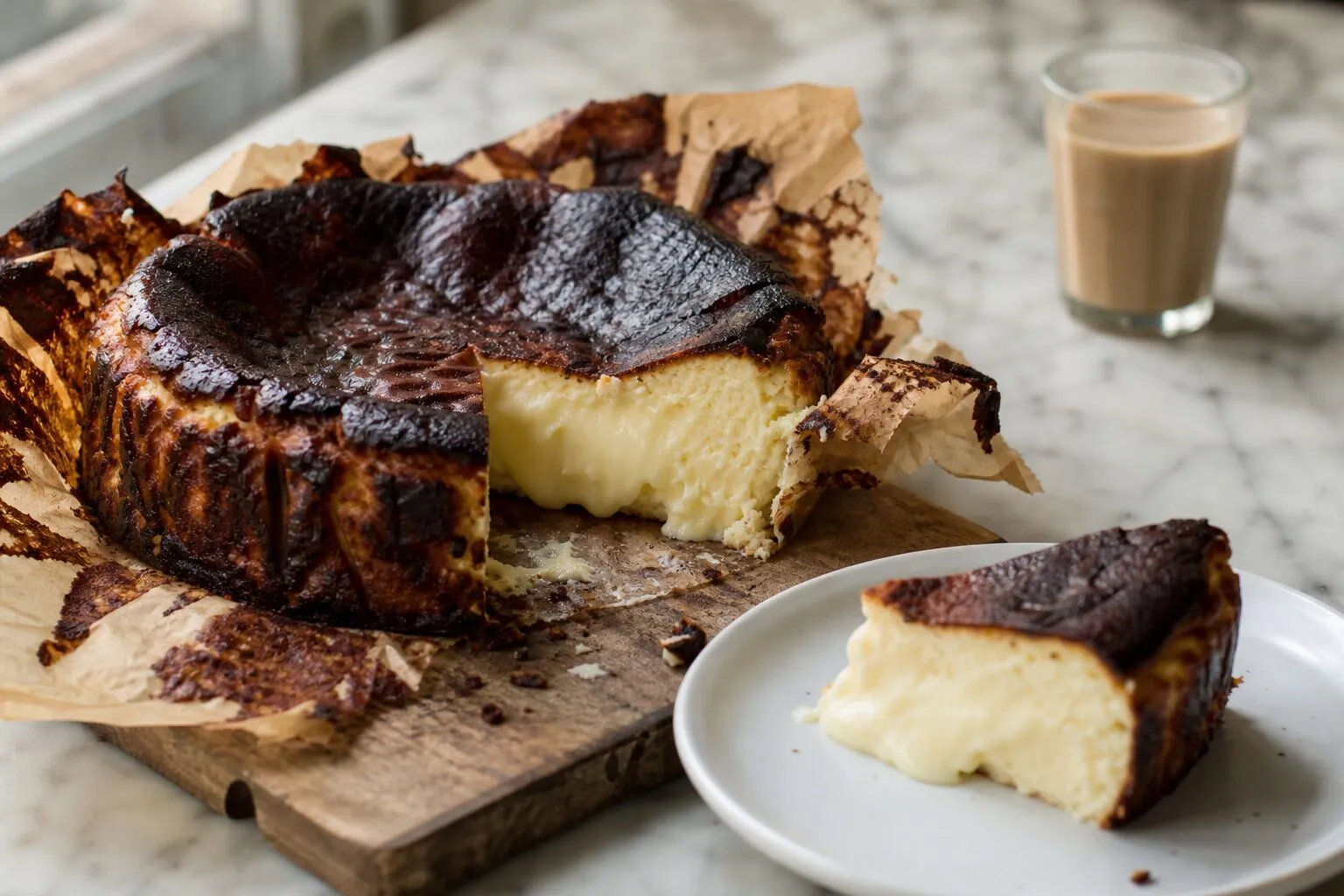
The cheesecake known abroad as Basque cheesecake was born in a single bar in San Sebastián, a port city in northern Spain. Its top is so deeply browned it looks black, and its center is soft and barely set. There is no biscuit crust, and it is baked in crumpled paper, which gives it a rustic look.
The only ingredients are cream cheese, eggs, sugar, cream and a very small amount of flour. This recipe keeps exactly to the ratios of the bar’s formula as published by San Sebastián’s city tourism office, scaled down to fit one 18 cm (7 in) round pan.
What is tarta de queso de La Viña?
In Spanish it is called tarta de queso de La Viña, “La Viña’s cheesecake.” Tarta de queso is simply the Spanish for cheesecake. In Spain the name tarta de queso vasca (Basque cheesecake) is also widely used, and in Basque it is gazta tarta. Abroad it spread under the names San Sebastián cheesecake and Basque cheesecake.
Born in an old-town bar
La Viña is a small, family-run bar on Calle 31 de Agosto (31 August Street) in the old town of San Sebastián (Donostia in Basque). According to the Spanish food media site Directo al Paladar, it was opened in 1959 by the parents of Santiago Rivera, who ran the bar for many years, together with his uncle and aunt.
Rivera took over the family bar and worked in its kitchen as the cook. According to an article in the newspaper El Independiente, it all started when he was experimenting with chocolate to get a mousse-like texture that melts in the mouth. Trying to get that same texture in a cheesecake, he got rid of the biscuit base, which was getting in the way. He recalls that there was no internet and no cooking school back then; he compared cookbooks and kept testing on his days off. The finished cakes were set out on the bar counter in front of the seating area, and at first, it is said, they sold one cake at a time.
Nobody knows for certain what year it was created. The newspaper El Español and most Directo al Paladar articles place it in the 1990s, but a 2025 opinion piece in Directo al Paladar says the 1980s. Rivera reportedly never tried to keep the recipe a secret for the bar, and doesn’t mind people copying it. The bar’s formula is also published on the website of San Sebastián’s city tourism office.
A cheesecake that went around the world
The city tourism office says word of mouth and the internet spread its reputation, and it became known in New York, Japan and Australia. In December 2020, New York Times reporter Kim Severson, in an article predicting food trends for 2021, named the flavor of this cheesecake as one likely to define 2021. Some Spanish articles describe this as the cheesecake having been chosen as the flavor of 2021.
In June 2026, Rivera’s retirement was reported (at 65, according to Directo al Paladar). The bar is reportedly passing to his two children and Mikel Castellanos, the bar’s manager, who has been a co-owner for about 30 years.
Not a traditional Basque sweet
Despite the “Basque” in its name, this is not a sweet that has long been made in the Basque Country. The Directo al Paladar opinion piece argues that because it was born in a single bar and has spread only recently, it is more accurate to call it tarta de queso de La Viña. The Catalan newspaper Ara also reports that the sweet San Sebastián locals love most is panchineta, made with puff pastry, almonds and pastry cream.
Tarta de queso de La Viña recipe: ingredients
Makes: One 18 cm (7 in) round cake (8 slices)Prep: 20 min (plus 1–2 hours to bring the ingredients to room temperature)Bake: 35–45 min (then chill for at least 4 hours)Difficulty: Easy
Preparing the pan
- Water (for wetting the parchment paper)200 ml (about ¾ cup)
Batter
- Cream cheese (block type, not the soft spread kind)600 g (about 21 oz)
- Granulated sugar240 g (about 1¼ cups)
- Eggs220 g (about 4 large eggs)
- All-purpose (plain) flour8 g (about 1 tbsp)
- Heavy (whipping) cream (dairy cream with at least 35% fat)300 ml (1¼ cups)
Equipment
- Round cake pan, 18 cm (7 in) (at least 6 cm (2½ in) deep. A pan with a removable bottom is easiest to use, but a regular pan works too)
- Parchment paper (30 cm (12 in) wide)
- Bowls (2 (one for wetting the paper, one for the batter))
- Rubber spatula
- Whisk
- Small fine-mesh sieve (for sifting the flour)
- Digital scale (to weigh the 8 g of flour)
- Thick oven mitts
- Wire rack
Method
Bring the ingredients to room temperature
Take 600 g (about 21 oz) cream cheese and 220 g (about 4 large) eggs out of the fridge and leave them at room temperature for 1–2 hours. The cream cheese should be soft enough that a finger pressed into it sinks in easily.
Line the pan and preheat the oven
Cut two 40 cm (16 in) lengths of parchment paper. Crumple each sheet into a ball, open it out again, dip it in a bowl of 200 ml (about ¾ cup) water, and wring it out firmly. Lay the two sheets across each other in the pan, pressing them against the bottom and sides, with 4–5 cm (1½–2 in) standing above the rim. Put a baking sheet on the lowest rack and preheat the oven to 210–220°C (410–430°F). Once the oven shows it has reached temperature, wait another 10 minutes.
Mix the cream cheese and sugar
Put the cream cheese in another bowl and work it with a rubber spatula until smooth. Add 240 g (about 1¼ cups) sugar and mix until it no longer feels gritty. Don't whisk; mix without beating in air.
Add the eggs
Add the 220 g (about 4 large) eggs one at a time, without beating them first, stirring gently with a whisk after each one. Wait until each egg is fully mixed in before adding the next.
Add the flour and cream
Sift in 8 g (about 1 tbsp) flour through the small sieve and mix until no dry flour shows. Add 300 ml (1¼ cups) cream in 3 additions, mixing after each, to make a smooth batter. If any lumps remain, strain the batter through the small sieve or a strainer.
Bake
Pour the batter into the pan, set it on the preheated baking sheet, and bake at 210–220°C (410–430°F) for 35–45 minutes. It is done when the top is a deep dark brown, black in places, and when you gently shake the pan, the outer 3–4 cm (1¼–1½ in) is set while the center, about 8–10 cm (3–4 in) across, wobbles like a custard pudding. If the top is still pale at 35 minutes, raise the oven to 230°C (445°F) and bake 3–5 minutes more. Even if the center looks loose, it firms up as it chills, so don't overbake.
Cool
Take the pan out with thick oven mitts and set it on a wire rack. The pan and the paper are very hot, so don't touch them with bare hands. The puffed-up cake will sink, and that's fine. Leave it in the pan at room temperature for 1–2 hours. Once it has cooled down, cover it with plastic wrap and refrigerate for at least 4 hours, preferably overnight.
Unmold and slice
When the cake is thoroughly chilled, lift it out of the pan by the paper and peel the paper off. Take it out of the fridge 30 minutes to 1 hour before eating, so the center turns creamy. Warm a knife in hot water, wipe it after every cut, and cut the cake into 8 slices.
Slice it and eat it as it is. Directo al Paladar’s recipe also suggests serving it with a blackberry sauce or fresh berries. It goes well with coffee, and with sweet wine too.
The food science: why it’s baked hot, with a burnt top and a soft center
The dark color comes from browned dairy and sugar
Food scientist Harold McGee describes cheesecake as a kind of custard, meant to be baked slowly at a fairly low temperature, for example in a water bath, so that it sets evenly. La Viña’s cheesecake does the opposite. The formula on the tourism office’s website bakes it hot, at 210°C (410°F) for about 40 minutes. Castellanos, the bar’s manager, has said that the bar bakes it in a gas oven set to 180°C (355°F) for 40 minutes. Because this recipe is baked in a home oven, it uses the tourism office formula’s 210°C (410°F) as its baseline.
Once the oven’s heat drives off the water at the surface of the batter, the surface temperature climbs above 100°C (212°F). According to McGee, above roughly 120–150°C (250–300°F) the Maillard reaction, in which proteins and sugars react to create color and a toasty flavor, speeds up sharply. This batter is full of milk protein and lactose (milk sugar), eggs and sugar, so it browns well. From around 160°C (320°F), caramelization, in which the sugar itself browns, also begins, and the top turns from a bittersweet dark brown to black.
The center comes out before the eggs have fully set
The center of the batter, on the other hand, heats up slowly. About half of the batter is water, and heat travels in from the outside only gradually.
Egg proteins begin to set at around 60°C (140°F). According to McGee, eggs diluted with milk and sugar set at a higher temperature, and only firm up at around 80°C (175°F). This batter is rich in cream cheese, cream and sugar, with a relatively small share of egg, so the center is likely to be even slower to set.
When the cake is baked hot and briefly, the center is still below the temperature at which the eggs fully set by the time the top has burnt. That is why the center wobbles when it comes out of the oven. If you bake it until the center no longer wobbles, it will chill to a texture closer to an ordinary cheesecake, firm all the way through.
This is also why you don’t whisk air into the batter. Air mixed into the batter expands in the oven. With a lot of air, the cake rises high and then sinks sharply or cracks as it cools.
The food science: why there’s barely a tablespoon of flour
A little flour holds the batter together
The tourism office’s article says the flour’s job is to bind the batter. When heated, the starch in flour absorbs water and swells, thickening the batter slightly. According to McGee, starch also keeps egg proteins from bonding too tightly to one another. That is why pastry cream, which contains flour, doesn’t curdle even when boiled. The amount of flour in this formula, however, is far smaller than in pastry cream, so how much it actually stops the edges, which bake at a high temperature, from curdling has not been confirmed.
More flour, less creaminess
With more starch, the starch network sets firmly as the cake cools, and the whole cake becomes firm. La Viña’s formula uses only about 1–1½ tbsp flour per 1 kg (2.2 lb) cream cheese. This recipe uses 8 g, less than 1% of the batter.
Some Spanish recipes use 50 g flour and suggest adding cornstarch for a firmer cake (OKDIARIO). The more flour you add, the more of the creamy center you lose.
The food science: why it’s chilled after baking
Carryover heat finishes the center
Straight out of the oven, the center is still loose. Even after you take it out, heat keeps moving from the hot outside toward the center, which sets a little more. Taking it out while it still wobbles allows for this carryover heat.
Milk fat firms up, so the cake can be sliced
According to McGee, milk fat melts completely at a little above body temperature, and much of it is solid at fridge temperature. While the cake is warm, the fat in the cream cheese and cream is melted, so the center runs like soup. Chilling firms up the fat, and the center becomes creamy but firm enough to slice. The tourism office’s article also says to unmold the cake only once it is thoroughly cold.
Straight from the fridge, though, it is firm and doesn’t feel as creamy. In a Directo al Paladar article, Madrid pastry chef David Fernández Cordobés recommends serving it at about 17–18°C (65°F). The article doesn’t say how long before serving to take it out, so this recipe suggests taking it out of the fridge 30 minutes to 1 hour before eating.
The center contains egg that is close to raw. Use fresh eggs, and put the cake in the fridge soon after it has cooled down. Because the oven is very hot, bake on the lowest rack so the edges of the paper stay away from the top heating element. The pan and paper are very hot after baking; handle them with thick oven mitts.
Other formulas found in Spain
- Directo al Paladar: bakes about 0.57 times the bar’s quantities in an 18–20 cm (7–8 in) pan. After baking, the cake is left in the switched-off oven with the door slightly open for 4–5 hours.
- Público: uses 300 g sugar and 30 g flour per 1 kg (2.2 lb) cream cheese, which makes it less sweet than the bar’s formula and higher in flour. It also adds vanilla (optional) and salt, and bakes in a 20–22 cm (8–9 in) pan at 210–220°C (410–430°F) for 40–50 minutes.
- OKDIARIO: uses 50 g flour and adds lemon zest, and the pan is buttered and floured. With that much flour, it bakes up firmer.
Substitutions
Everything in this recipe can be found in a supermarket. A few things to keep in mind when choosing:
- Cream: use dairy cream with at least 35% fat. A non-dairy whipping cream changes both the flavor and the way the cake sets when chilled.
- A pan with a removable bottom: you don’t need one. The paper covers the whole inside of the pan, so even with a fixed-bottom pan you can lift the cake out by the paper.
- A 20 cm (8 in) pan: works with the same quantities. The cake will be shallower, so expect it to need about 5 minutes less, and judge doneness by how the center wobbles.
Troubleshooting
- The top doesn’t turn dark brown: the oven isn’t hot enough. Wait another 10 minutes after the oven shows it has reached temperature before baking, and if the top is still pale at 35 minutes, raise the oven to 230°C (445°F) and bake 3–5 minutes more.
- It set firm all the way through: it was overbaked. Next time, take it out 5 minutes earlier, while the center still wobbles. Adding more flour also makes it firm.
- The center runs out when you slice it: it wasn’t chilled long enough, or it was underbaked. If it still runs after at least 4 hours in the fridge, bake it 3–5 minutes longer next time.
- The batter is lumpy: the cream cheese was still cold, or the cream went in all at once. Soften the cream cheese properly and add the cream in additions. Strain out any lumps that remain.
Storage
- Fridge: 2–3 days in a lidded container (only until the next day if just covered with plastic wrap). Because the center is barely set, don’t leave it at room temperature.
- Freezer: cut into slices and freeze for 1–2 hours until firm, then wrap each in two layers of plastic wrap; keeps 1–2 months. Move to a container and thaw overnight in the fridge (not at room temperature).
More from Spain & Portugal
Sources
- Donostia San Sebastián Turismoa, “Por qué la "San Sebastian cheesecake" conquista el mundo” (Spanish)
- Donostia San Sebastián Turismoa, “Zergatik Donostiako gazta tartak mundu osoa bereganatu duen” (Basque)
- El Español, “Adiós al 'padre' del postre vasco más internacional: Santiago Rivera, creador de la tarta de queso de La Viña, se jubila” (Spanish)
- Directo al Paladar, “Adiós al padre del postre más copiado de la historia: Santiago Rivera, inventor de la tarta de queso de La Viña, se jubila” (Spanish)
- Directo al Paladar, “Tarta de queso al horno de La Viña: receta fácil y tradicional” (Spanish)
- Directo al Paladar, “La Viña: cómo un pequeño bar de pintxos de Donostia logró crear la tarta de queso más famosa del mundo” (Spanish)
- Directo al Paladar, “The New York Times califica a la tarta de queso de La Viña como "sabor del año"” (Spanish)
- Directo al Paladar, “La tarta de queso vasca se ha hecho famosa en todo el mundo, pero de vasca tiene poco” (Spanish)
- El Independiente, “Tarta de queso: la historia del postre global que se remonta a los romanos” (Spanish)
- Público, “Receta de tarta vasca de queso” (Spanish)
- OKDIARIO, “Tarta de queso la Viña, receta tradicional” (Spanish)
- The Objective, “Soy experta en gastronomía y esta es, sin duda, la mejor tarta de queso del mundo” (Spanish)
- About Basque Country, “Gazta-Tartaren hedapen izugarria. Donostian jaioa eta munduaren konkistatzailea” (Basque)
- Ara en Castellano, “San Sebastián, capital de la panchineta, dice bastante a la moda inventada del pastel de queso” (Spanish)
- Directo al Paladar, “Cómo guardar la tarta de queso estilo La Viña: no te la juegues con las tartas fluidas” (Spanish)
- Directo al Paladar, “Esta es la temperatura perfecta para servir una tarta de queso, según uno de los mejores pasteleros de Madrid” (Spanish)
The text and recipe were put together independently after comparing the sources above.