Pão de LóRecipe
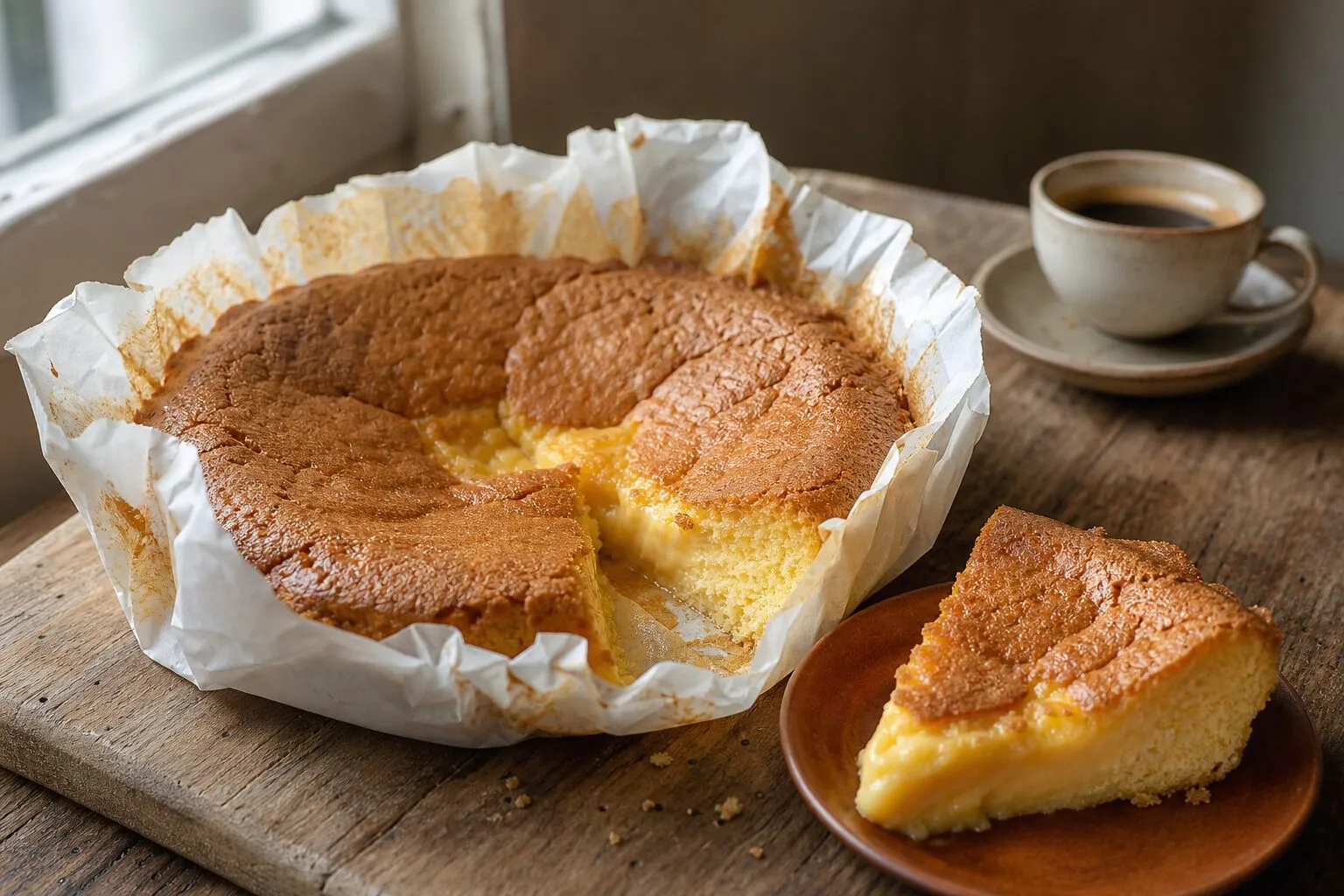
Pão de ló is a Portuguese sponge cake made by whisking eggs and sugar for a long time, then folding in just a little flour. The version here has no butter, no milk and no baking powder in the batter. The only thing that makes it rise is the air whipped into the eggs.
Many towns in Portugal have their own pão de ló. This one follows the style of Ovar, a town in the north. It uses a lot of egg yolks, is baked in a paper-lined pan, and is taken out of the oven while the center is still runny and half-cooked. It is baked in an ordinary 21 cm (8¼ in) round metal cake pan.
What is pão de ló?
In Portuguese it is written pão de ló (before the 1990 Orthographic Agreement, it was hyphenated: pão-de-ló). Pão means “bread,” but what ló refers to is not clear. An article in the Portuguese newspaper Observador gives two theories: that the name comes from Lot, a German pastry maker who is said to have invented the cake, or that ló was the name of a thin cloth once used to cover cakes. The article does not decide which is right.
The same Observador article describes pão de ló as a cake found everywhere that is also a specialty of Arouca, Alfeizerão, Ovar and Margaride. Portuguese recipe articles often present it as an Easter or Christmas cake, too. Depending on the place, it ranges from light and dry to almost liquid inside (see “Regional styles” below).
The convent story, and Ovar’s half-cooked style
The Portuguese cooking magazine Teleculinária traces the history of pão de ló back to the confectionery of 18th-century convents. The story goes that convents used egg whites to starch clothes and made sweets with the leftover yolks.
In 2016, pão de ló de Ovar was registered as an EU Protected Geographical Indication (PGI, a label only products made in a defined place by a set method may carry). The single document published in the Official Journal of the EU as part of the application cites a local priest’s account of the cake being given as a gift to the priests carrying the sacred objects in the Holy Week procession (the week before Easter) of 1781, and says it has been made since the end of the 18th century. According to the Portuguese news site 24 Notícias, it is made from eggs (mostly yolks), sugar and wheat flour, and baked in pans lined with white paper. The crust is thin, slightly moist and golden brown, and the inside is moist too. Small ones are called Infantes.
According to the single document, true pão de ló de Ovar is baked in paper-lined red or black fired-clay pans in an oven at 140–200°C (285–390°F) for 50 minutes to 2 hours. The center is creamy and may run out when cut. No Ponto, a website about Portuguese regional food, also says this moistness is not a sign of underbaking, but comes from the clay pans and the long baking time. On the other hand, the home recipe from e-konomista uses a metal round pan and bakes it for a short 35 minutes at 180°C (355°F). A skewer inserted in the center comes out wet: only the center is left half-cooked, giving it a center like egg cream. This recipe also uses that method and is “Ovar style,” different from the original method of slow baking in clay pans.
The ratios in this recipe
This recipe is based on the Ovar-style recipes from Teleculinária and from the Portuguese lifestyle website e-konomista. Both use very little flour compared with the eggs: 11–12 egg yolks and 2 whole eggs to 200–220 g sugar and 80 g flour. This recipe takes Teleculinária’s quantities for a 23 cm (9 in) pan (with the sugar set at 210 g, halfway between the two recipes) and scales them to a 21 cm (8¼ in) pan by the ratio of the pan areas.
Both home recipes add 1 tsp baking powder (e-konomista’s also uses self-raising flour). This recipe leaves it out, because the single document lists the ingredients of pão de ló de Ovar as eggs (mostly yolks), white sugar and wheat flour, with salt optional, and does not mention any raising agent.
Pão de Ló recipe: ingredients
Makes: One 21 cm (8¼ in) round cake, at least 6 cm (2½ in) deep (8 slices)Prep: 35 min (plus 30 min to bring the eggs to room temperature and 1½–2 hr cooling in the pan)Bake: 28–35 minutes (about 8–12 minutes more to bake the center through)Difficulty: Moderate
Preparing the pan
- Unsalted butter (softened at room temperature, for greasing the pan and paper)5 g (about 1 tsp)
Batter
- Egg yolks (from uncracked eggs within the date on the carton, at room temperature)180 g (about 10 large egg yolks)
- Whole egg (from uncracked eggs within the date on the carton, at room temperature; beat before weighing)85 g (about 1½ large eggs)
- Granulated sugar175 g (¾ cup plus 2 tbsp)
- Salt1 g (scant ¼ tsp)
- Cake flour (in place of the Portuguese type 55 wheat flour)67 g (about ½ cup plus 1½ tbsp)
Equipment
- Round cake pan (21 cm (8¼ in) across and at least 6 cm (2½ in) deep; a fixed-bottom pan (not loose-bottomed) is easiest)
- Baking paper (parchment) (one 40 cm (16 in) square sheet)
- Hand mixer (one that can keep whisking for 15–20 minutes)
- Digital scale (for weighing the yolks, whole egg and salt)
- Flour sifter or sieve
- Rubber spatula
- Bamboo skewer
- Wire rack
Method
Prepare the ingredients and the pan
Take the eggs out of the fridge about 30 minutes ahead to bring them to room temperature. Separate the eggs and weigh out 180 g (about 10 large) egg yolks. Beat another egg and weigh out 85 g whole egg. Sift the 67 g (about ½ cup plus 1½ tbsp) cake flour once. Brush half of the 5 g (about 1 tsp) butter thinly over the inside of the pan. Press the center of the 40 cm (16 in) square of baking paper onto the bottom of the pan and fit it against the sides, letting it fold into pleats. The paper should stand 3–4 cm (1¼–1½ in) above the rim. Brush the remaining butter thinly over the inside of the paper.
Whisk the eggs and sugar
Start preheating the oven to 180–185°C (355–365°F). Put 180 g egg yolks, 85 g whole egg, 175 g (¾ cup plus 2 tbsp) sugar and 1 g (scant ¼ tsp) salt in a large bowl and whisk with a hand mixer on high speed for 15–20 minutes. Keep going until the mixture is pale, thick and greatly increased in volume, and when you lift the beaters it falls back in folds like a ribbon that stays on the surface for 2–3 seconds. Rub a little between your fingertips: when you can no longer feel any grains of sugar, it is ready.
Fold in the flour
Sift the 67 g (about ½ cup plus 1½ tbsp) cake flour over the batter in 3 additions. After each one, fold it in with a rubber spatula, using big, slow strokes that scoop up from the bottom of the bowl and turn the batter over. Do not use the hand mixer. Stop as soon as no flour is visible.
Bake
Pour the batter into the pan and smooth the top lightly with the spatula. Bake on the middle rack at 180–185°C (355–365°F) for 28–35 minutes. It is done when the top is a deep golden brown, the area near the edge feels springy when pressed, and a skewer inserted about 3 cm (1¼ in) in from the edge of the pan comes out clean. The center should still wobble when you gently shake the pan, and a skewer there comes out coated in creamy batter (leaving the center half-cooked is what makes it Ovar style). If young children, older people, pregnant people or anyone in poor health will be eating it, bake the center through: lower the oven to 170°C (340°F), cover the top with foil if it looks like it might burn, and bake for about 8–12 minutes more. It is done when a skewer inserted in the center comes out clean. If batter still clings to it, bake 3–5 minutes longer at a time.
Cool in the pan
The pan is very hot, so take it out wearing oven mitts and set it on a wire rack. Leave the cake in the pan for 1½–2 hours, until completely cool. The center will sink as it cools; this is expected. Once cool, lift the cake out of the pan by the paper and cut it into slices with the paper still on. Eat the runny center with a spoon. If you baked it with a half-cooked center, eat it as soon as possible once it has cooled, and refrigerate any leftovers right away.
Cut it into slices with the paper still on, and eat the runny center with a spoon. It goes well with strong coffee.
The food science: rising on egg foam alone
Why whole-egg foam takes so long to whisk
Here the whites and yolks are whisked together rather than separately, and plenty of extra yolks are added to the whole egg. Egg yolks are rich in fat, and fat weakens the walls of the bubbles, so this foam takes longer to whip than a meringue made from whites alone. This is probably why Portuguese recipes call for a long 15–20 minutes with the mixer.
Sugar dissolves in the water in the eggs, making the liquid more viscous so that the bubble walls drain less easily. Food scientist Harold McGee explains that sugar stabilizes the foam, so it doesn’t collapse quickly. Whisking until you can no longer feel the sugar makes sure it is fully dissolved and can do this job. Eggs at room temperature also foam faster than cold ones.
In the oven, the air in the bubbles warms and expands, and some of the water in the batter turns to steam and pushes it out further. Meanwhile, the egg proteins set with the heat and become a framework that holds the risen shape. With no baking powder in this recipe, all the rise comes from this foam. Any bubbles you burst while folding in the flour mean less rise. That is why you use a rubber spatula with big strokes instead of the mixer.
With so little flour, the center stays creamy
In an ordinary sponge cake, the starch in the flour absorbs water and sets like a paste (gelatinization), forming the framework together with the eggs. In this recipe, the flour weighs only about a quarter as much as the eggs. Because the egg proteins provide almost all the structure, the center, where the heat doesn’t fully reach, stays runny instead of setting.
According to McGee, egg yolks thicken and begin to set at around 65–70°C (150–160°F). Lots of sugar raises the temperature at which egg proteins start to set even further. The oven’s heat travels in from the sides of the pan, so the batter sets at the edges first and the center sets later. That is why you can take the cake out when a skewer near the edge comes out clean while the center still wobbles.
Because the structure is weak, the center sinks as it cools. You cool it in the pan and lift it out by the paper only when cool because it breaks easily if moved while warm.
Egg safety when the center is half-cooked
A half-cooked center means the eggs are not fully cooked. Eggs can, rarely, carry salmonella (bacteria that cause food poisoning), which can survive if the eggs are not heated enough. Use eggs that have been kept in the fridge, are within the date on the carton and have no cracks. After baking, the half-cooked center also spoils easily, so eat the cake as soon as possible once it has cooled and refrigerate any leftovers right away.
If young children, older people, pregnant people or anyone in poor health will be eating it, don’t leave the center half-cooked: bake it, as at the end of step 4, until a skewer inserted in the center comes out clean.
Regional styles
- Ovar (north, Aveiro district): the style made in this recipe. It has lots of egg yolks, is baked in a pan lined with white paper, and is moist and creamy inside. The Portuguese lifestyle website e-konomista says an egg-cream center and paper stuck to the edges are the signs of the real thing.
- Alfeizerão (central Portugal, near Alcobaça): even closer to liquid inside. According to a Lusa news agency report carried by RTP, the Portuguese public broadcaster, it is baked in a round copper pan in a very hot oven for about 15 minutes. The recipe is said to have been passed on by nuns from the nearby convent at Cós. A legend told in the report has it that the style began when King Dom Carlos visited at the end of the 19th century and a nervous nun took the cake out of the oven too early. In 1925, a former parish priest of the town is said to have opened a shop dedicated to the cake, to spread a sweet that families made at home for celebrations.
- Margaride (north, Felgueiras): light, airy and baked all the way through. Teleculinária’s recipe uses 9 egg yolks and 3 whole eggs with 250 g sugar and 125 g flour, more flour than the Ovar style, and bakes it at 170°C (340°F) for about 35 minutes. According to Comércio com História, which profiles long-established Portuguese businesses, the Margaride bakery dates back, by tradition, to 1730 and received the title of supplier to the royal household in the 19th century.
- Arouca (north): according to Portuguese Wikipedia, it has been made since 1840 and is baked in a rectangular pan. The slices are coated in hot sugar syrup.
- Light, fluffy home style: the recipe featured by the radio station RFM (from the recipe site Petit Chef) separates 7 eggs and whisks the yolks and whites separately, adds 250 g sugar, 150 g flour and lemon or orange zest, and bakes at 180°C (355°F) for 25–30 minutes.
The link with Japanese castella
Portuguese Wikipedia says that the Portuguese who reached Japan in the 16th century took the method for making pão de ló with them, and that it became castella (kasutera), one of Japan’s best-known sweets (no source is given for this part). In the Lusa report carried by RTP, the owner of a long-established bakery in Alfeizerão says there is a similar cake in Japan and that Portuguese sailors probably passed on the method. However, the Portuguese sources used for this article do not say which town’s pão de ló reached Japan, or when or how.
Substitutions and other pan sizes
- Flour: Portuguese recipes just say “flour,” and the single document specifies “type 55” wheat flour. Judging by its protein content, type 55 seems close to all-purpose flour, but because this cake uses very little flour and relies on egg foam for its structure, this recipe uses cake flour. Bread flour or all-purpose flour develops more gluten (the elastic protein network that forms when flour is mixed with water), which tends to burst the foam.
- Paper: in Ovar the cake is baked in pans lined with white paper. At home, use baking paper (parchment) instead. Because the cake is sliced with the paper on, don’t cut the paper to fit the pan; line it with one large sheet folded into pleats.
- 23 cm (9 in) pan: this is Teleculinária’s original size. Use 216 g (about 12 large) egg yolks, 100 g (2 large) whole eggs, 210 g (about 1 cup) granulated sugar, 1 g (scant ¼ tsp) salt, 80 g (about ⅔ cup) cake flour and 6 g (about 1¼ tsp) butter for the pan, and bake for about 30–35 minutes (Teleculinária bakes it at 185°C / 365°F for about 30 minutes).
- 18 cm (7 in) pan (at least 6 cm / 2½ in deep): use 132 g (7–8 large) egg yolks, 60 g (about 1 large) whole egg, 130 g (about ⅔ cup) granulated sugar, 0.7 g (⅛ tsp) salt, 49 g (about ⅓ cup plus 1½ tbsp) cake flour and 4 g (about ¾ tsp) butter for the pan, and bake for about 25–30 minutes. This time is an estimate based on the diameter and does not come from the original recipe. Start checking after 20 minutes.
- Whatever the size of your pan, judge doneness not by the time but by the skewer test and the wobble described in step 4. If you are baking the center through, bake until a skewer inserted in the center comes out clean.
Troubleshooting
- It didn’t rise and is low and heavy: the eggs weren’t whisked enough, or the foam was knocked out while folding in the flour. Whisk until the ribbon stays on the surface for 2–3 seconds, and fold the flour in with big strokes of the spatula without overmixing. Cold eggs are harder to whip, so bring them to room temperature first.
- The center was so raw it ran everywhere: the baking time or temperature was too low. Bake 3–5 minutes longer at a time until a skewer inserted about 3 cm (1¼ in) in from the edge comes out clean. Check with an oven thermometer that your oven reaches the set temperature.
- The center set and became a dry sponge: it was overbaked. Next time, take it out while the center still wobbles when shaken. Smaller pans cook through faster, so if your pan is smaller than the one in this recipe, check early.
- The top burned: it was too close to the top heating element, or the temperature was too high. Bake on the middle rack, and once the top is well browned, cover it with foil for the rest of the time.
Storage
- Room temperature: if you baked it with a half-cooked center, eat it as soon as possible once it has cooled; don’t leave it out, and refrigerate any leftovers right away. A cake baked all the way through can stay at room temperature on the day it is baked, in cool weather.
- Fridge: wrap the cake, paper and all, in plastic wrap. Eat a half-cooked one by the next day, and one baked through within about 2 days. Take a half-cooked cake out of the fridge about 15 minutes before eating so the center becomes runny again.
- Leftover egg whites: they keep for 2–3 days in an airtight container in the fridge, or for 1 month in the freezer, and can be used for meringues and other bakes.
More from Spain & Portugal
Sources
- Teleculinária, “Pão de ló de Ovar” (Portuguese)
- e-konomista, “3 receitas de pão de ló para a época festiva” (Portuguese)
- Teleculinária, “Pão de ló de Margaride” (Portuguese)
- RFM, “Queres fazer pão de ló na Páscoa? Esta receita simples leva apenas 4 ingredientes” (Portuguese)
- 24 Notícias (SAPO), “Bruxelas classifica Pão de Ló de Ovar como produto protegido” (Portuguese)
- Official Journal of the European Union C 141 (22 April 2016; Polish version on infor.pl), “JEDNOLITY DOKUMENT "PÃO DE LÓ DE OVAR"” (Polish)
- No Ponto, “PÃO-DE-LÓ DE OVAR” (Portuguese)
- Observador, “Pão de Ló de Ovar, a tradição portuguesa que conquista o mundo” (Portuguese)
- RTP, “Pão-de-ló de Alfeizerão a caminho de ser marca certificada” (Portuguese)
- e-konomista, “Como escolher os melhores pães-de-ló para este Natal” (Portuguese)
- Observador, “Do bolo de arroz ao pastel de nata: cinco histórias açucaradas da nossa pastelaria” (Portuguese)
- Wikipédia, “Pão de ló” (Portuguese)
- Comércio com História, “Fabrica de Pão de Ló de Margaride” (English)
The text and recipe were put together independently after comparing the sources above.